


Expanded Perlite Production Line: Equipment & Output Guide
Perlite. It’s one of those materials that quietly shows up everywhere — in horticulture, construction, filtration, cryogenic insulation — yet the actual process of transforming raw volcanic ore into that lightweight, white, free-flowing material remains poorly understood outside specialist circles. If you’re evaluating whether to invest in an expanded perlite production line, or you’re already running one and want to benchmark your setup against industry standards, this guide covers the equipment, output expectations, and operational realities that matter most.
What Actually Happens During Perlite Expansion
Raw perlite ore is a glassy volcanic rock containing 2% to 5% combined water. When rapidly heated to 850–1100°C, the moisture vaporizes and the rock softens, making particles expand 4 to 20 times in volume. The final product is lightweight, chemically stable, and delivers great thermal insulation and drainage performance.
The process seems straightforward, yet many factories struggle to maintain consistent expansion during mass production, and prevent burnt material and uneven particle sizes.
Core Equipment in a Commercial Expanded Perlite Production Line
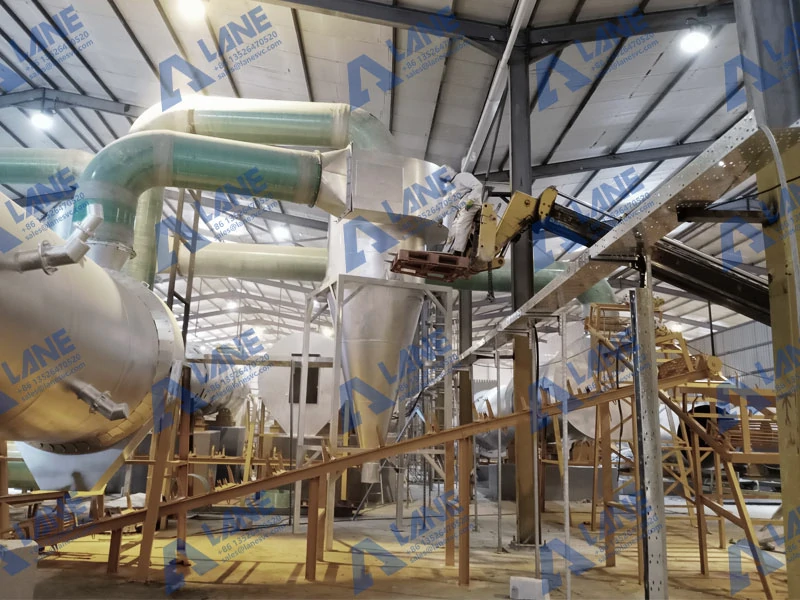
A well-engineered expanded perlite production line is not a single machine. It’s an integrated system. Each unit operation feeds directly into the next, and a bottleneck at any stage will cap your total throughput regardless of how powerful your furnace is.
Here’s what a complete line typically includes:
- Jaw Crusher— Primary size reduction of raw ore. Target particle size before expansion is generally 0.1–4mm, depending on the intended application grade.
- Rotary Dryer— Pre-drying the crushed ore is critical. Excess surface moisture causes inconsistent expansion and can damage furnace linings over time.
- Vibrating Screen— Classifies crushed material into size fractions before furnace feed. Don’t skip this step; feeding unsorted material is one of the most common causes of yield inconsistency.
- Vertical Expansion Furnace— The core piece of perlite expansion equipment. Hot gas currents carry ore particles upward through a high-temperature chamber. Residence time, temperature profile, and feed rate must all be precisely controlled.
- Cyclone dust collector— Separates expanded perlite from the hot gas stream immediately after the furnace. Recovery efficiency here directly affects your production yield.
- Dust Collector— Captures fine particles that pass through the cyclone. Environmental compliance requirement in virtually every market, and also recovers product that would otherwise be lost.
- Bucket Elevator— Transports expanded product to storage or packaging without crushing the lightweight, fragile granules.
- Automatic packaging machine— For commercial operations, automated valve bag filling and checkweighing systems are standard.
In my experience, the two pieces of perlite expansion equipment that most operators underinvest in are the grading screen and the dust collection system. Both look like secondary components on paper. Both will quietly destroy your margins if they’re undersized or poorly maintained.

Output Expectations: What’s Realistic?
Output capacity for an expanded perlite production line varies significantly based on furnace size, ore grade, and target product density. To give you a working reference:
Small-scale commercial lines (single furnace) typically produce 1,500–3,000 cubic meters of expanded product per day. Mid-scale operations with two to three furnaces in parallel commonly achieve 8,000–15,000 m³/day. Large integrated facilities — the kind supplying construction markets across entire regions — can exceed 30,000 m³/day.
Bulk density is critical for finished products. Horticultural perlite usually has a density of 80–130 kg/m³, while industrial insulation grades can drop to 50–70 kg/m³. The lower the density, the harder it is to control the expansion furnace, and the more care is needed in subsequent handling.
Real-World Operational Notes
To be frank, equipment manuals rarely mention this. The expansion furnace is the heart of production. Poor coordination between feed volume and furnace temperature will lead to heavy losses.
Even a slight overfeed will ruin expansion and cause uneven density. Defective products have to be reworked or scrapped. Many new plants run the furnace at full capacity right from the start. Workers haven’t gotten used to its temperature rules, so troubles often arise.
Equipment suppliers like LANE, which focuses primarily on industrial process equipment for materials production across fertilizer and bulk mineral processing sectors, often emphasize system integration over individual component specs — and that framing is genuinely correct. An expanded perlite production line performs to its potential only when airflow, temperature, feed rate, and classification are tuned as a unified system, not as isolated units.
Summary and Next Steps
Investing in an expanded perlite production line is a serious capital commitment, and the difference between a profitable operation and a frustrating one often comes down to equipment selection and system integration — not just furnace size or rated capacity.
If you’re at the planning stage, prioritize suppliers who can provide full-line engineering support, not just individual equipment sales. If you’re already operational and experiencing yield inconsistency, start your audit at the grading screen and the furnace feed control system — those are the most common root causes.
FAQ
Q1: What is the minimum viable scale for a commercial expanded perlite production line?
Most equipment manufacturers set the practical minimum at around 1,000 m³/day of expanded output for an expanded perlite production line. Below that threshold, the capital cost of a proper furnace, cyclone, and dust collection system rarely justifies the investment compared to purchasing finished expanded perlite from existing producers.
Q2: How long does it take to commission a new expanded perlite production line?
From equipment delivery to stable commercial production, most operators should plan for 3–6 months. This includes mechanical installation, refractory curing in the expansion furnace, trial runs, and operator training. Rushing the furnace curing phase is a common and expensive mistake.
Q3: What fuel types are compatible with perlite expansion furnaces?
Natural gas is the most common fuel for the expanded perlite production line in established markets due to price stability and combustion control. Heavy fuel oil and LPG are used where gas infrastructure is unavailable. Coal-fired furnaces exist in some markets but are increasingly restricted by emissions regulations. Furnace selection should always account for local fuel availability and environmental compliance requirements.
Q4: How do I control final product bulk density?
Bulk density is primarily controlled through ore particle size entering the furnace, furnace temperature, and residence time (controlled by vertical airflow velocity). Finer feed particles and higher temperatures produce lower density product. Most commercial operations target a specific density range for their primary market and calibrate feed and temperature accordingly.
Q5: What are the main causes of yield loss in perlite expansion operations?
The three most significant sources of yield loss are: (1) oversized or undersized feed particles bypassing the grading screen, (2) overfeeding the expansion furnace, which reduces expansion ratio and produces partially expanded ore, and (3) insufficient dust collection efficiency, which loses fine expanded product to exhaust streams.
Q6: Can a perlite expansion line be expanded in stages as demand grows?
Yes, and this is actually the recommended approach for most new market entrants. A well-designed expanded perlite production line can be built with a single expansion furnace initially, with civil works and utility infrastructure sized for a second or third furnace addition. Adding parallel furnaces is considerably more cost-effective than replacing an undersized system entirely.
For more details, please feel free to contact us.
Henan Lane Heavy Industry Machinery Technology Co., Ltd.
Email: sales@lanesvc.com
Contact number: +86 13526470520
Whatsapp: +86 13526470520

Send a message to us