


Calcium Sulfate Fertilizer Production Line: Equipment, Process & Cost Guide
Introduction
Setting up a calcium sulfate fertilizer production line is a significant capital decision. Whether you are a fertilizer manufacturer expanding into gypsum-based products, an investor evaluating a greenfield plant opportunity, or an engineering procurement team comparing technology suppliers, the choices you make at the planning stage determine your plant’s profitability for years to come.
Calcium sulfate fertilizers—derived from natural gypsum, phosphogypsum, or flue-gas desulfurization (FGD) gypsum—deliver calcium and sulfur, two secondary nutrients that directly impact crop yield and soil structure. Global production of calcium sulfate exceeded 170 million tons in 2025, with agricultural applications accounting for a growing share as soil degradation concerns drive demand for calcium- and sulfur-rich soil amendments.
This guide walks through every dimension of planning a calcium sulfate fertilizer production line: raw material options, process routes, equipment selection, granulation technology comparison, investment estimation, supplier evaluation, and ongoing operational considerations. The focus throughout is on what procurement decision-makers need to know before committing capital.
Why Invest in Calcium Sulfate Fertilizer Production?
The business case for a calcium sulfate fertilizer production line rests on three pillars: growing demand, feedstock availability, and product versatility.
Demand fundamentals. Calcium and sulfur are classified as secondary macronutrients, but their depletion in modern agricultural soils is well documented. Intensive farming practices, reduced atmospheric sulfur deposition from cleaner industrial emissions, and high-yield crop varieties have all contributed to widespread calcium and sulfur deficiency. Application rates for agricultural gypsum typically range from 500 to 2,000 kg per hectare, translating to steady and predictable market demand.
Feedstock advantage. Unlike nitrogen or phosphate fertilizers, which depend on energy-intensive ammonia synthesis or declining phosphate rock reserves, a calcium sulfate fertilizer production line can draw on multiple low-cost feedstocks. Phosphogypsum—a by-product of wet-process phosphoric acid manufacturing—is available in enormous quantities globally, much of it stored in above-ground stacks. FGD gypsum from coal-fired power plants offers another industrial-symbiosis opportunity. Natural gypsum deposits provide the third option. This feedstock flexibility insulates the business from single-supplier risk.
Product versatility. A modern gypsum fertilizer manufacturing plant can produce multiple product grades from the same line: raw gypsum powder for bulk soil application, granulated gypsum for precision spreading, blended NPK-plus-gypsum formulations, and specialty products such as urea calcium sulfate (UCS) adduct fertilizers. This versatility means a single production line can serve multiple customer segments—commodity agriculture, specialty crops, turf and ornamental markets, and organic farming.
Raw Material Options for Calcium Sulfate Fertilizer Manufacturing
The feedstock you select shapes your process design, equipment configuration, and operating cost structure. Three primary sources supply a gypsum fertilizer manufacturing plant.
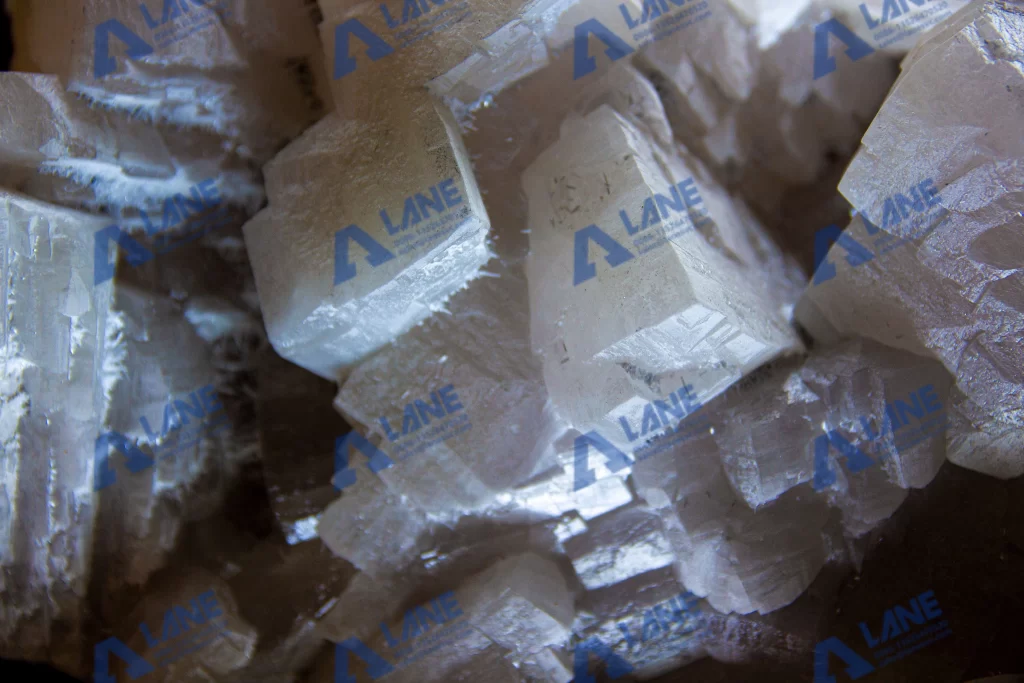
Natural gypsum (mined). Mined gypsum (CaSO₄·2H₂O) offers consistent purity and particle characteristics. Crushing and grinding circuits are straightforward, and the material requires no pre-treatment for contaminants. The trade-off is higher raw material cost compared to industrial by-product sources, plus the logistical burden of proximity to mine sites. Typical CaO content ranges from 22% to 32%, with sulfur at 14% to 18%.
Phosphogypsum. Phosphogypsum fertilizer production has gained traction as phosphate fertilizer manufacturers seek to monetize their waste streams. Phosphogypsum arrives wet (10–30% moisture) and carries residual acidity and P₂O₅ content—characteristics that can actually benefit adduct-type fertilizer reactions. The UCS (urea calcium sulfate) process, developed and patented by SABIC, operates efficiently on moist phosphogypsum at 30–60°C without pre-drying, converting an environmental liability into a value-added fertilizer product. For a new calcium sulfate fertilizer production line, co-location with a phosphoric acid plant can eliminate raw material costs almost entirely.
FGD gypsum (synthetic). Flue-gas desulfurization gypsum from coal-fired power stations provides another industrial by-product route. The SUL4R-PLUS facility in Marissa, Illinois exemplifies this model: a 100,000 ton-per-year granular calcium sulfate fertilizer plant that runs on synthetic gypsum supplied directly from an adjacent power plant. The product contains sulfur, calcium, and fulvic acid, with capacity expandable to 300,000 tons per year.
Feedstock decision matrix. When evaluating raw material options for a calcium sulfate fertilizer production line, weigh three factors: delivered cost per ton of CaSO₄ content, consistency of supply over a 10–15 year investment horizon, and any pre-processing requirements that add capital equipment (dewatering, contaminant removal, grinding). A plant designed for phosphogypsum cannot simply switch to natural gypsum without process modifications—so the feedstock decision is essentially permanent.
Calcium Sulfate Fertilizer Production Process: Step by Step
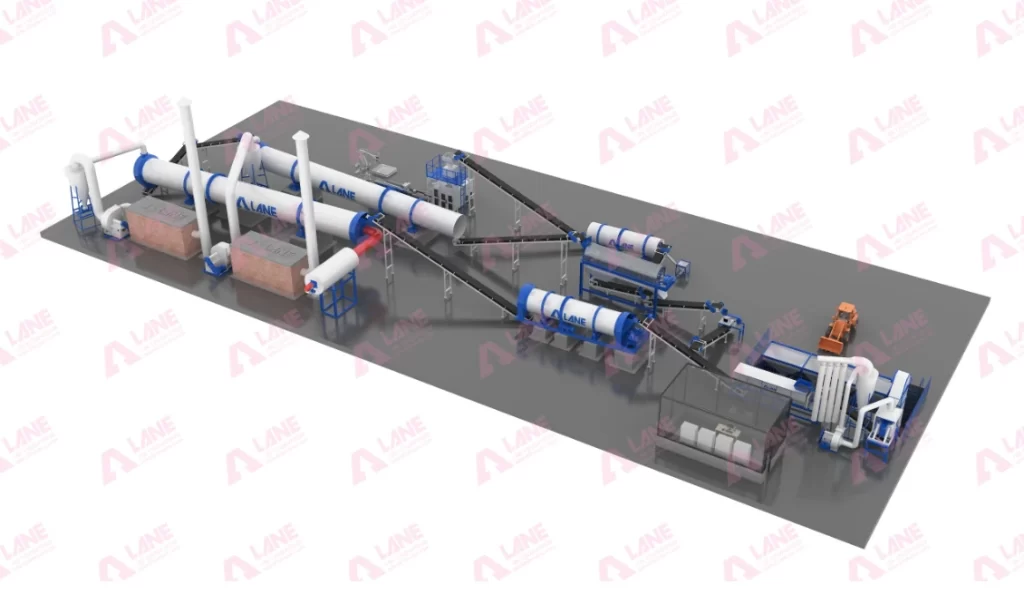
A typical calcium sulfate fertilizer production line follows a sequence of unit operations, each with distinct equipment requirements and process control parameters. The exact configuration depends on feedstock type and target product form, but the fundamental stages are consistent across most commercial installations.
Stage 1: Raw material reception and storage. Gypsum feedstock—whether mined rock, phosphogypsum filter cake, or FGD gypsum powder—arrives by truck, rail, or conveyor and enters covered storage. Moisture management at this stage is critical: for dry granulation routes, excess moisture causes bridging in silos and inconsistent feeding; for wet granulation, controlled moisture is an asset.
Stage 2: Crushing and size reduction. Mined gypsum rock (feed size up to 300 mm) passes through a jaw crusher for primary reduction to 20–30 mm, followed by a hammer crusher or cage crusher for secondary crushing. A typical cage crusher for a mid-scale line handles 6–10 tons per hour at 15 kW per rotor (dual-rotor configuration). For phosphogypsum, pre-grinding targets an average particle size of 100–250 μm, with 150 μm being optimal for UCS adduct reactions.
Stage 3: Grinding and classification. A Raymond mill or vertical roller mill reduces crushed material to final fineness of 80–200 mesh, power consumption running 18–35 kWh per ton. Cyclone separators return oversize to the mill. This stage determines surface area available for subsequent granulation or reaction, directly influencing product quality.
Stage 4: Mixing and formulation. Gypsum powder enters a continuous mixer—typically a rotary drum BB fertilizer mixer capable of 30–40 tons per hour—where it combines with nitrogen sources (urea, ammonium nitrate), phosphate materials (superphosphate), organic matter (compost, manure), and micronutrients according to the product recipe. For UCS production, urea dissolves into an aqueous slurry with gypsum at 60–90°C under high-shear mixing (≥50,000/second shear rate) to drive adduct formation.
Stage 5: Granulation. This is the defining stage of the production line. Multiple technologies compete here—rotary drum granulation, disc pan granulation, double roller extrusion, and fluidized bed granulation—each with distinct cost, quality, and operational trade-offs. A full comparison follows in the next section.
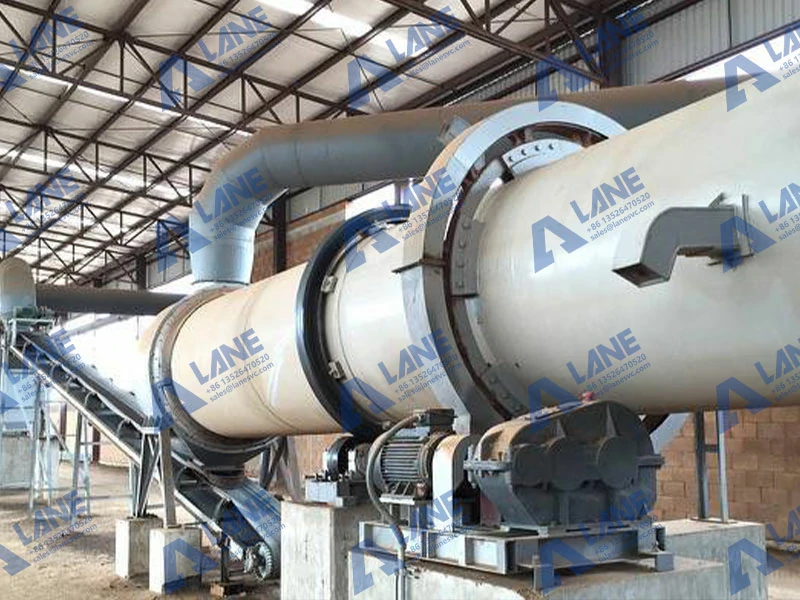
Stage 6: Drying and cooling. Wet granulation routes produce granules at 12–15% moisture that must drop below 2% for storage stability. Rotary dryers operating at 93–115°C inlet temperature, with thermal efficiency of 65% or higher, handle this duty. A downstream rotary cooler brings granule temperature below 40°C and improves crush strength to 15 N or above by setting the granule structure.
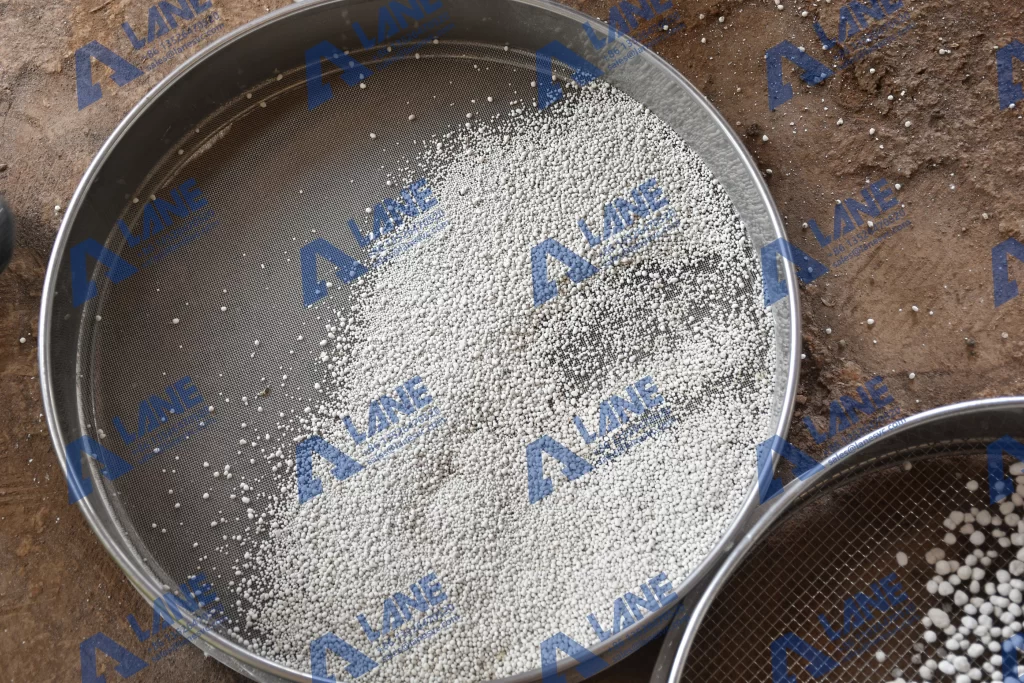
Stage 7: Screening, coating, and packaging. Vibrating screens separate on-spec product (typically 2–4 mm) from oversize and undersize. Oversize passes through a crusher and recycles to the granulator; undersize returns directly. A coating drum applies anti-caking agents. Automated bagging lines fill 25 kg, 50 kg, or 1,000 kg jumbo bags at 300–500 bags per hour with ±0.2% weight accuracy.
Core Equipment in a Calcium Sulfate Fertilizer Production Line
Equipment selection decisions cascade through the entire plant design. The following covers major equipment categories that procurement teams should specify in detail.
Crushing and grinding equipment. Jaw crushers handle primary reduction with capacities of 10–50 TPH. Cage crushers (e.g., model SXLSF-800, 380×320 mm inlet, 15×2 kW) deliver 6–10 TPH for secondary crushing. For fine grinding, Raymond mills with cyclone classifiers dominate in Asian-manufactured lines; vertical roller mills, while more capital-intensive, reduce power consumption by 15–20% over the equipment lifetime.
Mixing and reaction vessels. Continuous rotary drum mixers with customizable corrosion-resistant linings achieve 30–40 TPH throughput. For UCS production, high-shear rotor-stator mixers, colloid mills, or homogenizers capable of ≥50,000/second shear rates are specified. Reactor vessels for acid-route processes require 316L stainless steel construction with temperature-controlled jackets.
Granulation equipment. See the full comparison in the next section for detailed selection guidance.
Drying and cooling systems. Rotary dryers (typical dimensions: 2–4.2 m diameter × 15–29 m length, carbon steel SA-283 construction) with hot air furnaces provide the main drying duty. Counter-current airflow design maximizes thermal efficiency. Dust collection via pulse-jet bag filters maintains emissions below 30 mg/Nm³.
Material handling. Bucket elevators (centrifugal-discharge type, 18–43 ton/hour) for vertical lifts; screw conveyors (helicoid type, 10–20 ton/hour, 12–14 inch diameter) for horizontal transfer; belt conveyors (troughed, 20° idlers) for finished product movement to warehouse.
Control systems. PLC-based centralized control with touchscreen HMI, real-time monitoring of moisture, temperature, and throughput at each stage, and remote diagnostic capability. Modern lines increasingly incorporate IIoT sensors for predictive maintenance.
Granulation Technology Comparison
Choosing the right granulation method for your calcium sulfate fertilizer production line is arguably the most consequential equipment decision. Four technologies dominate the market.
Rotary drum granulation. The industry workhorse. A rotating drum (typically 3.2 m diameter, 37 kW drive, 15–30 TPH capacity) tumbles material while water or binder solution sprays onto the rolling bed. Particles agglomerate through liquid bridging and capillary forces. Best suited for high-throughput operations and blends where moisture addition is acceptable. The downside: requires downstream drying, increasing both capital cost and energy consumption. Granulation rate exceeds 90% with proper recycle ratio management.
Disc pan granulation. A tilted rotating disc (1–6 TPH capacity) produces spherical granules through a rolling snowball mechanism. Granule size distribution is narrower than drum granulation, and the equipment cost is lower. Balling rate reaches 85% or higher. However, throughput per unit is significantly lower than drum granulation, making this technology better suited to small-to-medium capacity lines or specialty product runs.
Double roller extrusion (dry granulation). Powder feeds between two counter-rotating rollers under high pressure, forming a compacted sheet that is then crushed and screened to target granule size. The key advantage: no water addition and no drying required. Energy consumption drops 30–40% compared to wet granulation routes. Capacities range from 1–8 TPH. Ideal for phosphogypsum fertilizer production where the feedstock already carries moisture, or for operations in regions with high energy costs. Granulation rate exceeds 98%—the highest of any method. The trade-off is that granules are angular rather than spherical, which some agricultural spreading equipment handles less efficiently.
Fluidized bed granulation. A specialized method using calcium sulfate hemihydrate as a self-binding agent. Material fluidizes in a heated, humidified air stream (45–65°C, 85–95% RH) while water spray triggers hemihydrate-to-dihydrate rehydration, causing particles to agglomerate. Produces hard, porous granules suitable as agricultural chemical carriers. Process time is fast (2–20 minutes for a 50 lb batch), but throughput is limited compared to continuous rotary drum systems.
Selection guideline. For a high-capacity commodity-grade calcium sulfate fertilizer production line (50,000+ TPY), rotary drum granulation with dryer circuit is the standard choice. For medium-capacity or energy-sensitive operations, double roller extrusion offers the best operating economics. Disc pan granulation suits specialty products and smaller-scale plants. Fluidized bed technology occupies a niche for carrier-grade granules.
Plant Setup: Capacity Planning, Layout & Investment
Capacity planning. Annual capacity should match your market access, not your ambition. A 100,000 TPY plant requires 8,000–15,000 m² of land, with a modular design approach allowing phased expansion—start at 50,000 TPY, prove the market, then add a second parallel line. Equipment throughput typically ranges from 5–30 TPH depending on configuration. Project timelines from engineering design through commissioning run approximately 4–6 months for modular, skid-mounted designs from experienced EPC suppliers.
Investment estimation. Total capital investment for a calcium sulfate fertilizer production line varies dramatically with capacity, feedstock type, and technology sophistication. Available pre-feasibility studies indicate a range of $30 million to $85+ million for plants in the 100,000–800,000 TPY range. Machinery (crushers, mills, granulators, dryers, packaging systems) represents the largest CapEx line item, followed by land, civil works, and installation. Raw materials account for 50–60% of operating expenditure, which is why co-location with a gypsum source—phosphogypsum stack, FGD source, or gypsum mine—is the single most powerful lever on project economics.
Key financial metrics from published studies:
- Gross profit margin: 25–35%
- Net profit margin: 12–18%
- Return on investment (pre-tax): 22–33%
- Payback period: 2.4–4.0 years
- Break-even point: 47–55% of capacity
Utility requirements. A 100,000 TPY gypsum fertilizer manufacturing plant requires reliable three-phase power (380V/220V or as specified), process water, natural gas or coal for drying heat, and compressed air for instrumentation. Total installed power typically ranges from 200–500 kW depending on grinding and granulation technology choices.
Supplier Selection: How to Evaluate Production Line Manufacturers
The supplier landscape for calcium sulfate fertilizer production lines is concentrated among Chinese engineering firms, with growing competition from Indian manufacturers. Supplier evaluation should focus on five dimensions:
Technical capability. Examine reference plants the supplier has delivered that match your feedstock type and capacity range. A supplier experienced in natural gypsum may not understand phosphogypsum’s handling challenges. Request a detailed equipment list with model numbers, materials of construction, motor ratings, and country of origin for key components (motors, bearings, PLC systems, gearboxes).
After-sales support. Warranty periods in this industry range from 1 to 5 years. However, the more practical concern is ongoing spare parts availability and technical support responsiveness. Suppliers with established international service networks, remote diagnostic capability, and regional spare parts warehouses significantly reduce production downtime risk.
Certification and standards. ISO 9001:2015 is the minimum quality management standard. CE certification matters for lines destined for European or Middle Eastern markets. For UCS or specialty processes, verify that the supplier has experience with the specific reaction chemistry and can provide process performance guarantees for adduct conversion rates, granule crush strength, and moisture specifications.
EPC vs. equipment-only. Some suppliers offer turnkey EPC (Engineering, Procurement, Construction) contracts covering design, manufacturing, civil works, installation, commissioning, and operator training. Others supply equipment only, leaving integration to the buyer. For a first-time plant investor, EPC delivery reduces project risk substantially, even at a 15–25% premium over equipment-only procurement.
Site visits and references. Before signing, visit at least two operating reference plants. Speak directly with plant managers about equipment reliability, actual vs. rated throughput, spare parts lead times, and any post-commissioning issues. A supplier unwilling to arrange reference visits should raise a red flag.
Operational Best Practices & Maintenance
A calcium sulfate fertilizer production line operates in a dusty, sometimes corrosive environment. Gypsum is abrasive; phosphogypsum is both abrasive and acidic. Maintenance planning must account for these realities.
Predictive maintenance. Install vibration sensors on crushers, mills, and granulator drive systems. Gypsum dust accelerates bearing wear—vibration trending catches deterioration before catastrophic failure. Conveyor belt thickness monitoring prevents unexpected downtime on material handling systems.
Corrosion management. For phosphogypsum fertilizer production lines, specify 316L stainless steel for all wetted surfaces in the reaction, mixing, and granulation sections. Carbon steel in the drying and cooling sections requires regular inspection, as residual acidity in the product stream can concentrate during drying and attack vessel walls.
Wear parts inventory. Crusher hammers, mill grinding rollers, granulator liners, and screen meshes are consumable items. Maintain at least two sets of each in inventory. Lead times for replacement parts from overseas suppliers can extend to 8–12 weeks.
Operator training. A well-trained operations team prevents more downtime than any maintenance program. Commissioning should include structured operator training covering normal operation, startup/shutdown sequences, troubleshooting common faults, and safety protocols. Many turnkey suppliers include this in their EPC scope; confirm the training duration and curriculum detail during contract negotiation.
Frequently Asked Questions
What is the difference between a calcium sulfate fertilizer production line and a standard NPK fertilizer line?
A calcium sulfate fertilizer production line requires specific material handling adaptations for gypsum’s abrasive and hygroscopic properties. The granulation stage also differs: gypsum-based formulations often use dry roller extrusion rather than steam granulation, eliminating the need for a drying circuit and reducing energy consumption. For UCS (urea calcium sulfate) production, high-shear mixing equipment—rotor-stator mixers or colloid mills operating at ≥50,000/second shear rate—is unique to this chemistry and not found in standard NPK lines.
How much does a complete gypsum fertilizer manufacturing plant cost?
Total capital investment for a gypsum fertilizer manufacturing plant ranges from approximately $30 million for a 100,000 TPY facility to $85 million or more for larger installations. The largest cost components are machinery (crushers, mills, granulators, dryers, packaging), followed by land, civil works, and installation. Co-locating the plant with a phosphogypsum or FGD gypsum source can substantially reduce raw material costs and improve project economics.
Can phosphogypsum be used directly in a calcium sulfate fertilizer production line?
Yes. Phosphogypsum fertilizer production is commercially established, with the UCS adduct process specifically designed for moist phosphogypsum at 10–30% moisture and 30–60°C—conditions matching fresh filter cake from a phosphoric acid plant. Using phosphogypsum directly eliminates the energy-intensive drying step required for stored, dry gypsum stacks. However, the production line must use corrosion-resistant materials (316L stainless steel for wetted surfaces) to handle residual acidity.
What granulation method is best for calcium sulfate fertilizer?
For high-capacity commodity production (50,000+ TPY), rotary drum granulation remains the industry standard. For medium-capacity or energy-sensitive operations, double roller extrusion granulation offers 30–40% lower energy consumption by eliminating the drying stage, with granulation rates exceeding 98%. Disc pan granulation suits smaller-scale specialty products. The choice depends on your target capacity, energy costs, and product specifications.
What are the key quality specifications for calcium sulfate fertilizer granules?
Industry-standard specifications include: granule size 2–4 mm diameter (90% within range), crush strength ≥15 N, moisture content ≤2% after drying, and free-flowing characteristics at ambient temperature. For UCS-type products, calcium sulfate urea adduct content should exceed 80%, with typical nitrogen content of 33–35%, calcium 3–5%, and sulfur 3–5%.
Which countries have the strongest demand for calcium sulfate fertilizer?
Demand is strongest in regions with intensive agriculture and documented sulfur/calcium deficiency: Brazil (soybean and corn belts), India (sulfur-deficient soils across multiple states), the United States (Pacific Northwest wheat country, Midwest corn/soybean), Western Canada (canola), and Southeast Asia (palm oil plantations). Markets with aging soils and reduced atmospheric sulfur deposition—essentially most of the developed agricultural world—represent growing demand centers.
Conclusion
A calcium sulfate fertilizer production line represents a capital-intensive but fundamentally sound industrial investment. The feedstock flexibility—natural gypsum, phosphogypsum, or FGD gypsum—provides a hedge against raw material cost volatility that few other fertilizer categories can match. The product addresses a genuine agronomic need that is growing, not shrinking, as global soil calcium and sulfur depletion continues.
The critical success factors are threefold: secure a long-term, cost-advantaged feedstock position before breaking ground; select granulation technology that matches your target market’s product form requirements and your local energy cost structure; and choose a supplier with demonstrated experience in your specific feedstock type—not just general fertilizer equipment manufacturing.
For procurement teams and investors evaluating a gypsum fertilizer manufacturing plant, the numbers work: gross margins of 25–35%, payback in 2.5–4 years, and a product with durable, agronomically-driven demand. The execution is where value is created or destroyed. Invest the time in reference visits, feedstock analysis, and technology selection upfront—the production line you build will operate for 15–20 years.

Send a message to us