


The Complete Guide to Mineral Fertilizer for Vegetables: Maximize Yield and Soil Health
Feeding a vegetable garden sounds simple until you actually do it. The gap between “plants look okay” and “plants are thriving” often comes down to one thing — nutrition. Specifically, the right mineral fertilizer for vegetables, applied at the right time, in the right form. Get that wrong and you’re either burning roots or watching slow, yellowing crops that never hit their potential.
This guide covers what actually matters: nutrient science, product types, application timing, and the equipment behind commercial-scale production.
Why Minerals Matter More Than Most Growers Realize
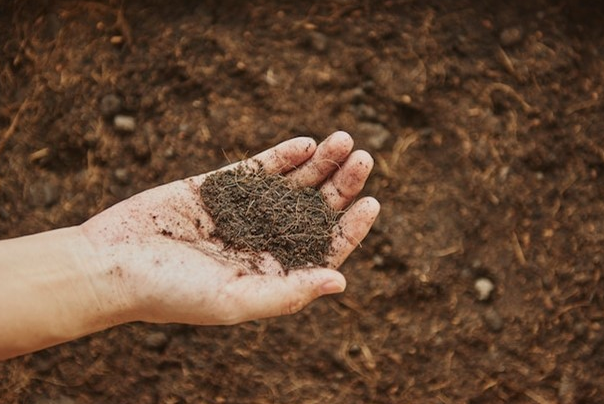
Soil is not just dirt. It’s a system — and that system depletes. Every harvest pulls nitrogen, phosphorus, potassium, calcium, magnesium, and a dozen trace elements out of the ground. Organic matter helps, but it rarely replaces what’s lost fast enough for high-yield production.
That’s where vegetable mineral fertilizer comes in. Unlike organic amendments, mineral-based products deliver nutrients in forms that plants can absorb almost immediately. For commercial operations growing tomatoes, leafy greens, brassicas, or root vegetables at scale, that uptake speed isn’t a luxury. It’s essential.
I’ve spoken with growers in East Africa and Southeast Asia who switched to balanced mineral fertilizer for vegetables after years of relying on compost alone. The yield difference, especially in phosphorus-deficient soils, was significant — sometimes 30–40% in the first season.
Core Nutrients and What They Do
Nitrogen (N) drives leaf and stem development. Too little and plants stunt. Too much and you get all foliage, minimal fruit. Phosphorus (P) is critical for root establishment and flower-to-fruit conversion. Potassium (K) regulates water use, disease resistance, and sugar transport — especially important for tomatoes, peppers, and cucumbers.
Secondary nutrients — calcium, magnesium, sulfur — are often overlooked until deficiency symptoms show up: tip burn, interveinal chlorosis, poor cell wall integrity. At that point, correcting the problem mid-season is harder and more expensive than preventing it.
A well-formulated vegetable mineral fertilizer addresses all three macros plus these secondary elements in a single application, reducing complexity and application costs.
Types of Mineral Fertilizer for Vegetables
Single Superphosphate (SSP) remains one of the most widely used phosphate sources in developing markets. Produced from rock phosphate and sulfuric acid, SSP delivers both phosphorus and sulfur — a useful dual benefit for sulfur-deficient soils common in Sub-Saharan Africa and South Asia. For vegetable cultivation on a budget, SSP is hard to beat on cost-per-nutrient.
NPK compound fertilizers offer balanced nutrition in a single granule. Formulations like 15-15-15 or 12-24-12 are designed for different crop phases — higher-N blends for vegetative growth, higher-P/K blends for fruiting and root development. For commercial vegetable producers, compound fertilizers simplify logistics considerably.
Urea (46-0-0) is the most concentrated nitrogen source available. It’s cost-efficient but requires precise application — over-application or surface broadcasting without incorporation leads to nitrogen volatilization losses that can reach 30% or more in warm climates.
Potassium sulfate (SOP) and potassium chloride (MOP) serve as potassium sources for vegetables with different chloride sensitivity. Tomatoes, potatoes, and leafy greens generally tolerate MOP well; strawberries and some herbs benefit from chloride-free SOP.
Equipment Behind Large-Scale Production
Understanding the machinery that produces mineral fertilizer for vegetables helps buyers evaluate product quality and supplier credibility. At industrial scale, key production systems include:
- Double superphosphate (DSP) production lines— for high-analysis phosphate production requiring sulfuric acid reactors, den conveyors, and curing chambers
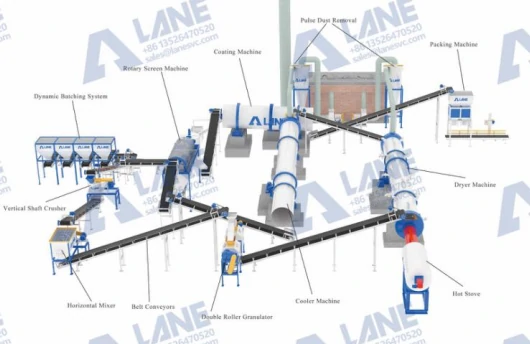
- NPK compound fertilizer production lines— including rotary drum granulators, dryers, coolers, and screening systems that determine granule uniformity
- Single superphosphate (SSP) production lines— typically combining a mixer reactor, belt conveyor, and curing warehouse; simpler than DSP but still requiring precise acid-to-rock ratios
- Organic-inorganic compound fertilizer production lines— which integrate organic feedstocks with mineral inputs through continuous blending and granulation
- Fertilizer packaging machines— automated bagging and weighing systems that ensure consistent product weight and reduce contamination risk
LANE, a large-scale fertilizer production equipment manufacturer, designs and supplies many of these systems to producers across Africa, the Middle East, and South Asia. Equipment quality directly affects nutrient uniformity in the final product — which matters when you’re formulating vegetable mineral fertilizer for precision agriculture applications.
Application Timing and Rates
For most vegetable crops, a base application at transplanting or bed preparation — incorporating SSP or a balanced NPK compound — establishes the phosphorus bank that plants draw on through the season. Nitrogen is better split: half at planting, half as a side-dress four to six weeks in, or through fertigation if the system supports it.
Soil testing changes everything. Without a baseline reading, even the best mineral fertilizer for vegetables can miss the mark. Over-application of phosphorus, for instance, locks out zinc and iron — trace deficiencies that reduce yield in ways that look like disease rather than nutrition.
FAQ
Q: Is mineral fertilizer safe for vegetable consumption?
A: Yes, when applied according to label rates and with appropriate pre-harvest intervals. Mineral nutrients are absorbed and metabolized by the plant; they don’t accumulate in edible tissue under normal use conditions.
Q: Can I combine mineral and organic fertilizers?
A: Absolutely — and this is often the best approach. Organic matter improves soil structure and water retention while vegetable mineral fertilizer supplies the precise nutrient concentrations that organic inputs alone struggle to deliver consistently.
Q: How do I calculate application rates for vegetable mineral fertilizer?
A: Base rates on your crop’s documented nutrient removal values, adjusted for your soil test results. Most extension services publish crop-specific fertilizer guidelines. For commercial operations, consulting an agronomist and running tissue tests mid-season adds another layer of accuracy.
Q: What’s the shelf life of mineral fertilizers?
A: Properly stored — cool, dry, away from moisture — most mineral fertilizer for vegetables has a practical shelf life of two to three years without significant nutrient degradation. Hygroscopic products like urea and ammonium nitrate require more careful storage conditions.
Getting nutrition right in vegetable production isn’t complicated — but it does require intentionality. The right vegetable mineral fertilizer, matched to your soil and crop, is one of the highest-return investments a grower can make.
For more details, please feel free to contact us.
Henan Lane Heavy Industry Machinery Technology Co., Ltd.
Email: sales@lanesvc.com
Contact number: +86 13526470520
Whatsapp: +86 13526470520

Send a message to us