


How to Choose Potash Fertilizer Manufacturing Equipment
Choosing the right potash fertilizer manufacturing equipment is one of the most consequential decisions a production facility manager will make. Get it right, and you set up your operation for years of stable, profitable output. Get it wrong — and trust me, I’ve seen this happen more times than I’d like — you’re looking at costly retrofits, production bottlenecks, and equipment that simply doesn’t match your raw material or output requirements.
This guide meticulously outlines various considerations, ranging from core machinery to process configurations, with the aim of assisting procurement teams and factory engineers in making informed, well-reasoned decisions.
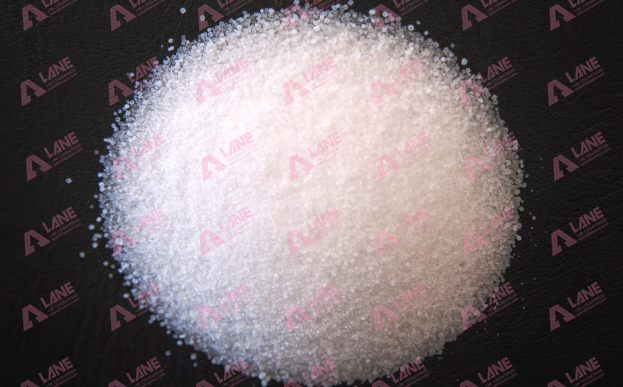
Understanding Your Production Goals First
Before evaluating any equipment, you need to lock down your production parameters. Output volume, target granule size, moisture tolerance, and potash source material all directly influence which machinery configuration makes sense. Potash fertilizer production from sylvite ore looks nothing like production from potassium sulfate blends. These are not interchangeable setups.
Based on my experience working with fertilizer producers in Southeast Asia and Sub-Saharan Africa, one of the biggest mistakes in procurement is to focus too early on equipment specifications before clearly defining the process objectives. Please avoid doing so.
Start by asking yourself a few questions: What is my annual production capacity target in terms of tons? Do I need to granulate, compact, or mix the material? Am I processing high-chloride potassium or potassium sulfate? The answers to these questions will determine everything that follows.
Core Potash Fertilizer Manufacturing Equipment You’ll Need
Once your process goals are defined, you can start mapping out the equipment line. Here’s what a standard potash fertilizer manufacturing equipment setup typically includes:
- Rotary drum granulator— The workhorse of wet granulation lines. It shapes raw potash material into uniform granules through tumbling and binder addition. Look for drum diameter-to-length ratios suited to your throughput.
- Double roller granulator— Ideal for dry compaction when moisture-sensitive materials are involved. No binder needed, which simplifies downstream drying.
- Rotary drum dryer— Removes post-granulation moisture to hit your target specification. Pay close attention to inlet/outlet temperature ranges and residence time.
- Rotary drum cooler— Reduces granule temperature before screening and bagging. Often overlooked, but skipping adequate cooling leads to caking problems in storage.
- Vibrating screen— Separates on-spec granules from oversized and undersized fractions. Multi-deck configurations improve classification accuracy.
- Raymond mill— Handles the grinding of return material and raw potash inputs before granulation. Consistent particle size from the mill directly affects granule quality.
- Belt conveyor system— Connects every station in the line. Stainless-lined conveyors matter more than people think when handling potassium chloride, which is mildly corrosive over time.
- Bag filter / dust collector— Non-negotiable for regulatory compliance and worker safety. Potash dust is irritating and, in sufficient concentrations, a housekeeping hazard.
- Automatic batching and weighing system— Especially critical for compound fertilizer blends that incorporate potash alongside nitrogen and phosphate sources.
This isn’t a shopping list to check off blindly. The actual configuration of your potash fertilizer manufacturing equipment line depends on capacity, budget, and process chemistry.
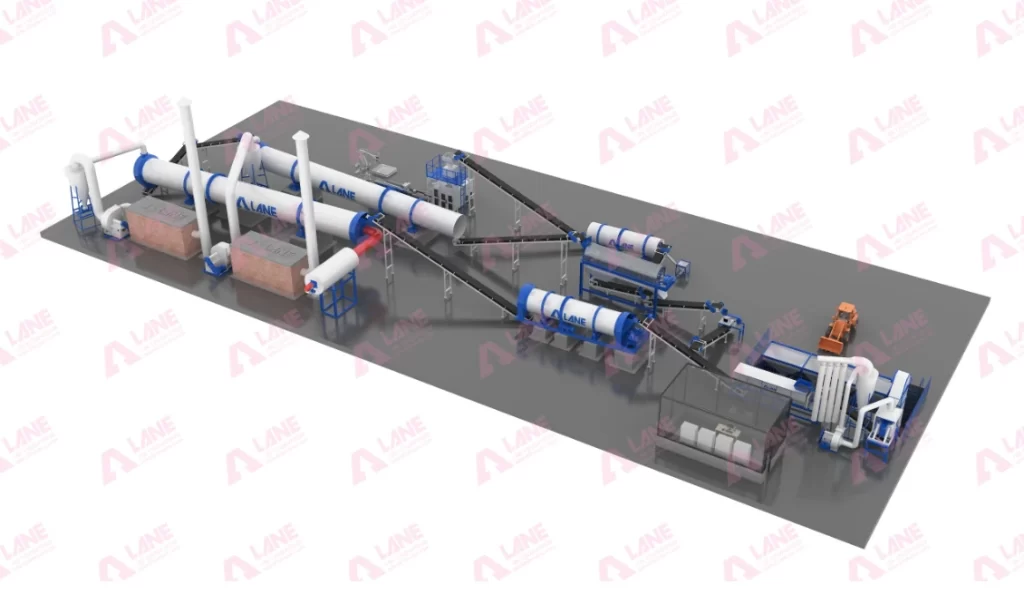
What to Evaluate When Comparing Equipment Suppliers
The procurement team often feels overwhelmed here, as they need to compare suppliers from different countries, with varying price points and vastly different technical specifications. But let me tell you – the specifications sheet does not fully capture the situation.
Material and build quality should be your first filter. Carbon steel with proper coating is acceptable for most dry potash lines, but wet granulation systems handling sulfate-based potash should use corrosion-resistant alloys in contact zones.
After-sales support and spare parts availability matter enormously for long-term operations. I’ve seen plants in East Africa run into six-week wait times for a single roller bearing because their supplier had no regional distribution. That’s production loss that no warranty covers.
Automation level is increasingly a differentiator. Modern potash fertilizer production lines in competitive markets now incorporate PLC-controlled process monitoring, real-time moisture feedback, and automated granule sampling. If a supplier is still selling fully manual systems at mid-to-high capacity ranges, that’s a red flag.
Manufacturers like LANE have built a strong regional presence in developing markets specifically because they combine competitive pricing on potash fertilizer manufacturing equipment with local-language technical support and accessible spare parts logistics — a combination that’s genuinely rare in this segment.
Capacity Planning and Scalability
If a fertilizer plant with a design capacity of 10 tons per hour is unable to meet production demands within three years, it would be a tragic consequence of inadequate specifications.
Therefore, when collaborating with suppliers, it is essential not only to simulate current capacity requirements but also to forecast growth over the next five years. Employing modular equipment configurations allows for the phased expansion of capacity without the need to replace the entire production line. For instance, a rotary drum granulator with a design capacity of 20 tons per hour can still be utilized even if it is currently operating at only 12 tons per hour. This is not a waste of resources but rather a strategic capacity reserve for future growth.
Potash fertilizer production scale-up is not always linear. Granulation dynamics, drying curves, and screening efficiency all shift as you increase throughput. Any supplier worth their contract should be able to walk you through these technical inflection points, not just hand you a capacity table.
Red Flags to Watch For
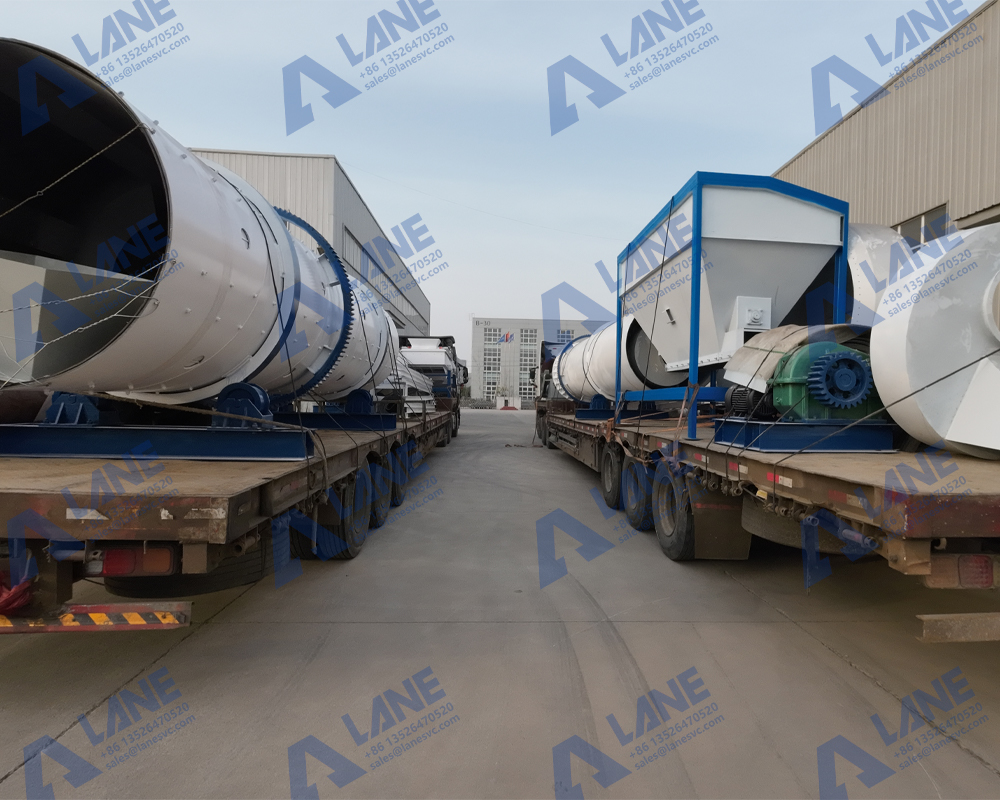
Suppliers who can’t provide real operating reference plants. Ask for site visits or video documentation of their equipment in actual potash fertilizer production environments. Renders and simulation videos are not evidence.
Equipment guaranteed for potash applications but spec’d out with components clearly designed for generic NPK blending lines. Potash has specific abrasion and corrosion characteristics. Generic isn’t good enough.
Extremely low pricing without a clear explanation. Equipment that undercuts the market by 30–40% almost always reflects compromises in steel grade, motor quality, or heat treatment standards that will surface within 18 months of operation.
Conclusion
Selecting the right potash fertilizer manufacturing equipment is a process that rewards careful, methodical evaluation over rushed procurement. Define your production goals. Map your equipment line against your process chemistry. Scrutinize suppliers on build quality, after-sales capability, and their demonstrated track record in actual potash fertilizer production environments.
The upfront effort is worth it. Equipment that’s properly matched to your process will pay back its investment many times over in operational reliability and product consistency.
Frequently Asked Questions
Q1: What is the most important piece of equipment in a potash fertilizer manufacturing line?
It depends on your granulation method. For wet granulation, the rotary drum granulator is central — it dictates granule uniformity and output rate. For dry compaction lines, the double roller extrusion granulator plays that defining role. Both require well-matched upstream and downstream equipment to function effectively.
Q2: Can the same equipment be used for both potash fertilizer production and NPK compound fertilizer?
Some equipment, like belt conveyor systems, vibrating screens, and rotary drum dryers, can serve both applications with minimal modification. However, granulation equipment and reactor systems are often process-specific. Always confirm compatibility with your supplier before assuming cross-use.
Q3: What annual capacity range is considered viable for a standalone potash fertilizer manufacturing equipment line?
Most commercially viable standalone lines operate between 5,000 and 100,000 metric tons per year. Below 5,000 MT/year, the capital cost-per-ton economics rarely justify dedicated equipment. Above 100,000 MT/year, multi-line configurations are typically more operationally resilient than a single oversized line.
Q4: How do I evaluate the corrosion resistance of potash fertilizer manufacturing equipment?
Request material certifications for all wetted and high-contact components. Key areas include granulator drum liners, dryer flights, conveyor impact zones, and mixer paddles. For muriate of potash (MOP) lines, chloride stress corrosion is a real concern and should be addressed explicitly in the equipment specification.
Q5: What automation features should I prioritize in modern potash fertilizer production lines?
PLC-based process control, real-time moisture monitoring in the dryer circuit, automated granule sampling systems, and remote diagnostic capability are now considered baseline expectations for competitive operations. These features reduce labor dependency and significantly improve batch-to-batch consistency.
Q6: How long does it typically take to commission a complete potash fertilizer manufacturing equipment line?
For a standard 10–30 T/H line, commissioning from equipment delivery to stable rated output typically runs 60 to 120 days, depending on site infrastructure readiness, supplier support quality, and operator training completion. Complex multi-product lines or custom configurations may require additional time.
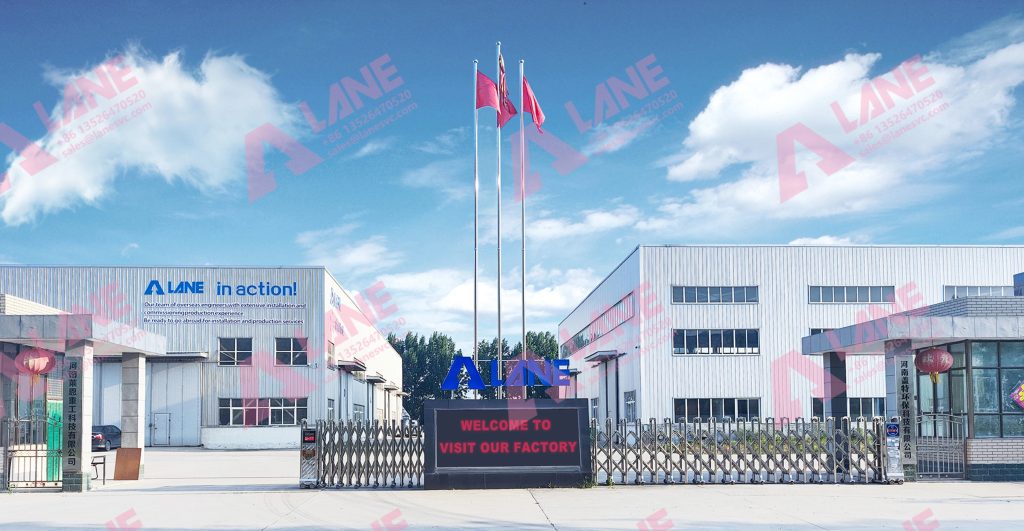
For more details, please feel free to contact us.
Henan Lane Heavy Industry Machinery Technology Co., Ltd.
Email: sales@lanesvc.com
Contact number: +86 13526470520
Whatsapp: +86 13526470520

Send a message to us