


How to Choose the Right Mineral Fertilizer Production Line: Capacity, Cost & Equipment Breakdown
Choosing the wrong production setup can cost you years of efficiency — and more money than most producers want to admit. I’ve seen it happen. A mid-sized operation in Southeast Asia invested heavily in an oversized mineral fertilizer production line, only to run it at 40% capacity for the first three years. The equipment wasn’t wrong. The match was.
This is actually the real difficulty. The problem is never to find the so-called “best” production line, but to find the solution that really fits your project needs – including your target capacity, raw material characteristics, and future expansion plans. After all, what works for someone else’s configuration may not necessarily be right for your factory. The first really important step in every mineral fertilizer production line project is to ask the right question first.
What Defines a Mineral Fertilizer Production Line?
At its core, a mineral fertilizer production line is an integrated sequence of mechanical and chemical processing units designed to convert raw mineral inputs — phosphate rock, potassium salts, nitrogen compounds — into granular or powdered fertilizer products suitable for agricultural or industrial use.
The configuration varies significantly depending on the target fertilizer type: compound NPK, single superphosphate (SSP), or straight nitrogen products, each of which demands a different process logic. You can’t treat these lines as interchangeable. To be honest, that’s where a lot of early-stage buyers get tripped up — they assume a “standard” setup exists. It doesn’t.
Core Equipment You’ll Find in Most Lines
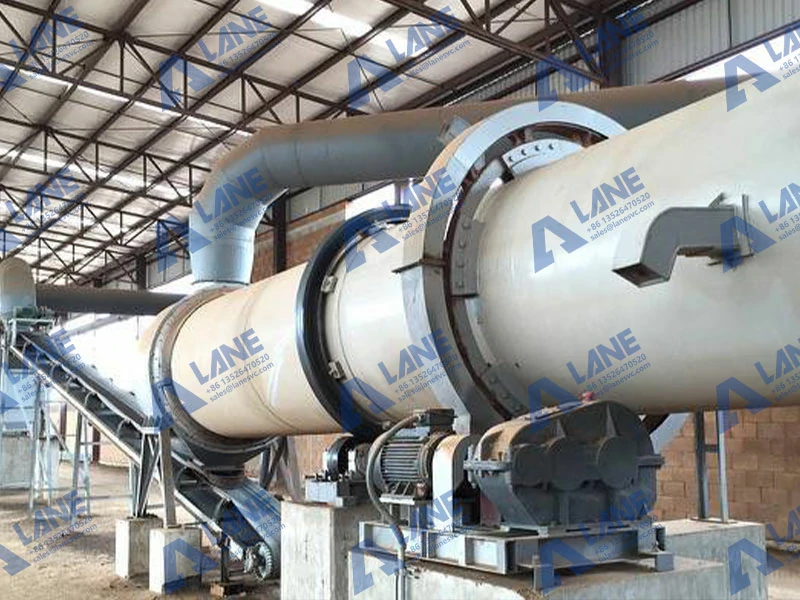
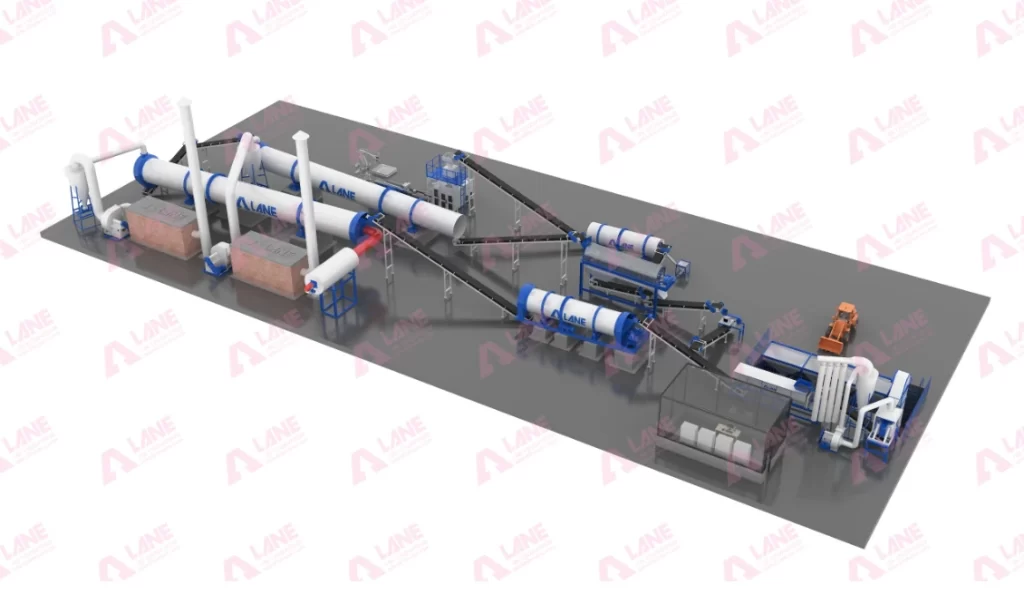
The specific machines vary by product type, but any well-engineered mineral fertilizer production line will include some combination of the following units:
- crusher— primary size reduction of raw mineral ore or rock phosphate
- Raymond mill— fine grinding to achieve the required particle fineness for the downstream reaction
- Single superphosphate reactor mixer— acidulation unit for SSP-type production processes
- Rotary drum granulator— high-capacity wet granulation, widely used in NPK and SSP compound lines
- Rotary drum dryer cooler—Removes post-granulation moisture for stability and cools the product down before screening.
- Vibrating screen— particle size classification; oversized material returns to crusher loop
- Belt conveyor system— continuous material transport between process stations
- Automatic packaging machine— final packaging unit for sacked product output
Each of these pieces has to be sized correctly relative to the others. A granulator running at 10 tons per hour fed by a dryer rated at 6 tons per hour — that’s a bottleneck waiting to happen. From what I’ve seen in the field, mismatched equipment capacity is the single most common design error in smaller fertilizer plant projects.
Capacity Planning: Where Most Buyers Underestimate
Start With Annual Demand, Not Daily Output
Many people’s first reaction is to push back the equipment configuration according to the daily target output. As a starting point, this idea is fine. But experienced plant managers understand that equipment utilization is often more important than nameplate capacity.
A production line with a nominal capacity of 20 tons/hour but an actual utilization rate of only 75% is likely to be inferior to a production line with a nominal capacity of 15 tons/hour but can stably run to 95% utilization rate in terms of economic benefits.
Therefore, when planning, we should not only look at the theoretical production capacity, but also take into account more practical factors, such as:
- l Plan maintenance intervals
- l Seasonal supply fluctuations in raw materials
- The stability of the local power grid power supply
These are not assumptions on paper, but real variables that affect production capacity. In some parts of East Africa and Central Asia, for example, the actual annual capacity of a plant can be reduced by 15%–20% due to power instability alone. This often has a greater impact on investment returns than many people think.
Scale in Phases When Possible
If your demand projections carry real uncertainty — and in most emerging markets, they do — consider a phased capital approach. Build the civil infrastructure and utility connections for full capacity from day one, but commission only the process units you need now. This approach, which manufacturers like LANE often support through modular equipment packages, reduces initial CAPEX without sacrificing future scalability. It also means your fertilizer plant can grow incrementally as market demand justifies the investment.
Cost Breakdown: What You’re Actually Paying For
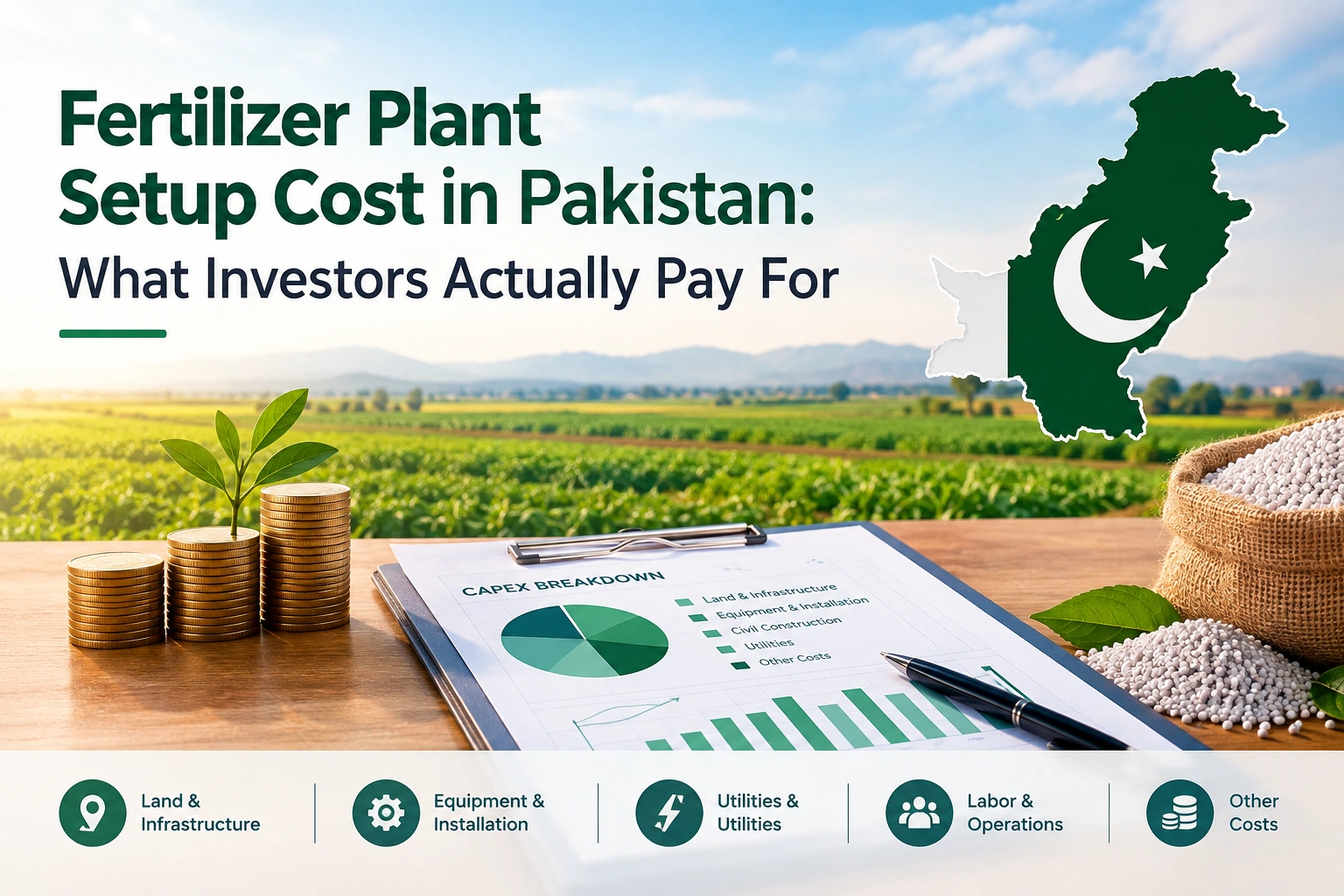
Equipment cost is only one layer. A complete mineral fertilizer production line budget typically includes:
Civil and structural works — foundations, buildings, storage silos. Often underbudgeted by 20–30% on first-time projects.
Utilities infrastructure — electrical supply, water systems, compressed air. These vary enormously by site location.
Installation and commissioning — experienced erection teams matter. Don’t let a vendor quote you FOB prices and leave the rest to chance.
Operator training and spare parts inventory — critical for operational continuity, especially in regions with limited local technical support.
In fact, the supply of spare parts is an issue that almost every buyer I have worked with will pay attention to in advance. The reason is simple: the equipment itself is not the only cost; downtime is the really expensive part. For example, if a rotary drum dryer does not prepare critical wearing parts, such as spare riding rings, in advance, it is essentially waiting for a problem to occur, but it is only a matter of time. Downtime during peak production periods is often very costly, not only lost throughput, but can also affect lead times, damaging customer trust and long-term relationships.
Site Selection and Fertilizer Plant Infrastructure
Before any equipment arrives on site, the fertilizer plant foundation work shapes everything that follows. Soil bearing capacity, proximity to raw material supply, road access for bulk delivery — these site factors directly affect both construction cost and long-term operational logistics. I’ve reviewed projects where poor site selection added 18 months to the commissioning timeline. That’s not a small miscalculation.
The same logic applies to utilities. A mineral fertilizer production line running on an undersized power feed is a permanent operational constraint. Build the utility infrastructure for your eventual full-scale capacity, even if you’re starting small. Every mineral fertilizer production line project I’ve evaluated has had at least one utility-related delay — plan ahead, and you can avoid the most common ones.
Matching Line Type to Product Strategy
Your mineral fertilizer production line configuration should follow your product strategy, not the other way around. Producers targeting bulk commodity markets — straight potassium chloride or SSP — typically prioritize throughput and low per-unit cost. That means larger drums, higher automation, and simpler chemical processes.
Producers moving into specialty compound NPK or coated slow-release products need more flexibility. Multi-product lines with adjustable granulator parameters and blending capacity are worth the higher initial investment if your market mix is likely to shift.
LANE’s engineering team, for instance, has configured lines serving both commodity SSP producers in North Africa and specialty NPK manufacturers in South Asia — the equipment overlap between those two setups is actually smaller than most people expect.
Final Thoughts
Let me tell you what experienced plant developers know, and first-time buyers often learn the hard way: the spec sheet comparison is the easy part. The hard part is matching a mineral fertilizer production line to the actual constraints of your site, your team, your market, and your cash flow timeline.
Take the time to do that match properly. Get references from producers running similar lines in similar conditions. Ask hard questions about commissioning timelines and post-sale support. And don’t optimize purely for the lowest equipment price — optimize for the lowest cost per ton over a ten-year operating horizon.
FAQ
Q1: What is the typical output range for a mineral fertilizer production line?
Output capacity varies widely — small lines start at 1–5 t/h for localized production, while large industrial setups can exceed 50 t/h. Most mid-sized commercial operations fall in the 10–30 t/h range.
Q2: How long does it take to commission a full production line?
From equipment delivery to stable operation, commissioning typically takes 3–6 months, depending on site readiness, equipment complexity, and operator experience. SSP lines with acidulation systems tend to take longer than dry-process NPK blending lines.
Q3: Can one production line handle multiple fertilizer formulas?
Yes, with proper design. Multi-product lines require adjustable granulation parameters, flexible raw material feed systems, and thorough cleaning protocols between product runs. The trade-off is higher complexity and slightly lower per-product throughput efficiency.
Q4: What are the highest hidden costs in a fertilizer plant project?
Civil works, utilities infrastructure, and spare parts inventory are consistently underestimated. Operator training and initial raw material inventory are also high costs that don’t appear on equipment quotations.
Q5: How do I determine the right granulator type for my product?
The choice between a rotary drum granulator, disc granulator, or extrusion granulator depends on your raw material moisture content, desired granule size distribution, and production volume. Wet-process materials favor drum or disc granulation; dry-process compound fertilizers often suit extrusion methods better.
Q6: What should I ask a supplier before purchasing a production line?
Ask for references from operating plants of similar scale and product type. Request commissioning timelines in writing. Clarify what’s included in after-sales support — specifically, technical visits, remote diagnostics, and spare parts lead times. A supplier who deflects on any of these questions is worth treating with caution.
Q7: How does fertilizer plant location affect overall project cost?
Significantly. A fertilizer plant situated far from ports or raw material sources will face higher logistics costs that compound over the production lifetime. Proximity to agricultural end-markets also matters for distribution efficiency. Site selection should be evaluated as a strategic long-term decision, not just a land-cost calculation.
For more details, please feel free to contact us.
Henan Lane Heavy Industry Machinery Technology Co., Ltd.
Email: sales@lanesvc.com
Contact number: +86 13526470520
Whatsapp: +86 13526470520
Send a message to us