


Mineral Fertilizer for Soil Improvement: Proven Methods That Boost Yield and Cut Input Costs
There’s a conversation I keep having with producers across Sub-Saharan Africa and the Middle East. They’re watching their yields plateau — sometimes decline — and they can’t figure out why. The land isn’t exhausted. The climate hasn’t shifted dramatically. The answer, almost every time, is sitting right beneath the surface: soil nutrient deficiency correction that was never properly addressed in the first place.
Mineral fertilizer for soil improvement isn’t a new concept. But applying it strategically, at scale, with the right equipment and the right timing — that’s where most operations fall short.
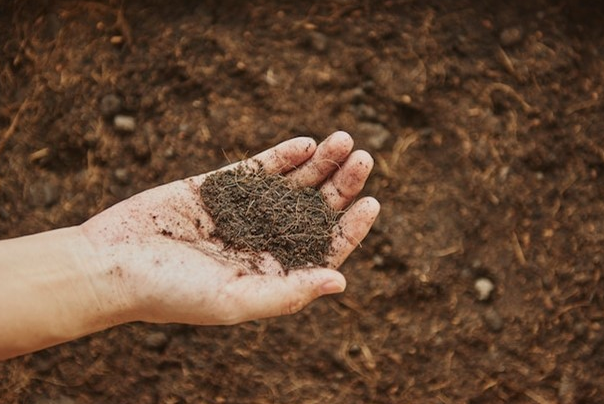
Why Soil Nutrient Deficiency Correction Matters More Than Producers Realize
Soil infertility is often difficult to detect. You’ll find reduced seed germination rates, uneven crop canopy, and that even increased irrigation doesn’t improve yields. By the time soil testing confirms the underlying conditions, the crop growing season has already been affected.
Based on my observations on the ground—working directly with fertilizer plant operators in Ethiopia, Egypt, and Southeast Asia—the biggest misconception is viewing the correction of soil nutrient deficiencies as a one-off solution. The reality is far more complex. Soil maintenance requires long-term, consistent management; once nutrient imbalances are addressed, maintaining a stable state is crucial. This necessitates a continuous and stable replenishment of high-quality mineral nutrients, and one must not rely solely on low monthly prices for intermittent and haphazard fertilization.
During plant growth and development, the core mineral nutrients—nitrogen, phosphorus, potassium, and sulfur—as well as minor micronutrients such as zinc and boron, each play a specific role. The absence of any one of these elements, regardless of how abundant the supply of other elements, will affect the entire system.
Mineral Fertilizer for Soil Improvement: The Production Side
Here’s something the agronomy textbooks don’t spend enough time on: the quality of the mineral fertilizer product itself determines much of your outcome. Granule size consistency, nutrient release rate, moisture content — these are manufacturing variables, not agricultural ones. And they matter enormously.
Producers serious about long-term soil improvement outcomes are increasingly investing in their own fertilizer production capacity. It’s a logical move. You control the formulation. You control the quality. You’re not dependent on import supply chains that can snap without warning.
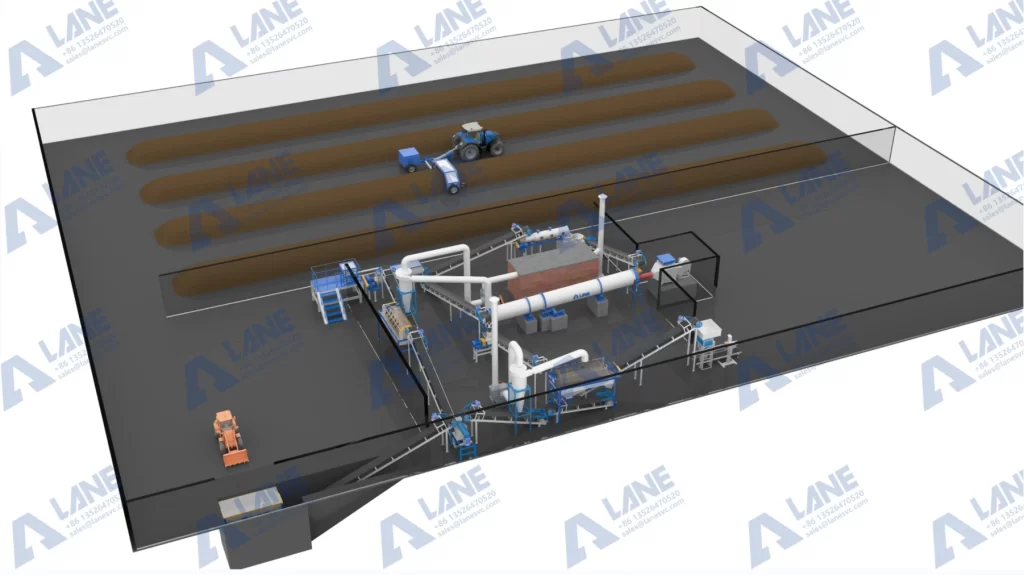
The core equipment in a well-designed mineral fertilizer production line includes:
- Rotary drum granulator— the central granulation unit, responsible for forming uniform fertilizer granules from powdered or slurried nutrient inputs; granule consistency directly affects field application evenness
- Disc granulator— widely used for NPK and single-nutrient mineral fertilizer production at small-to-medium scale; offers precise particle size control
- Drum Dryer and Cooler—Removes excess moisture and cools granules to prevent caking and ensure structural integrity before screening.
- Rotary drum screener— separates on-spec granules from oversized and undersized particles; oversized material is returned to the crusher, undersized to the granulator
- Single superphosphate (SSP) reactor— used specifically in SSP-type mineral fertilizer lines where phosphate rock is treated with sulfuric acid to release available phosphorus
- Belt conveyor system— connects each processing stage; often underestimated, but conveyor layout directly impacts throughput efficiency
- Automatic packaging machine— ensures consistent bag weights and reduces operator labor requirements at output stage
In my experience, the configuration of this line — specifically how the dryer, cooler, and screener are sequenced — has a larger impact on final product quality than most producers expect going in.
What Actually Works in the Field
To put it bluntly, there are countless agricultural resources on the market explaining the soil-improving effects of mineral fertilizers, with detailed and comprehensive content. However, most of these studies are conducted under ideal experimental conditions, while actual planting conditions in the fields are much more complex.
For example, farmers growing crops in humid tropical climates face problems with soil compaction and high moisture absorption, problems that simply don’t exist in the Middle East. Conversely, extremely arid soils require fertilizers formulated to release nutrients quickly and have a slow-release buffering effect—otherwise, applied nutrients will be largely lost through volatilization before being absorbed by the roots.
Under these conditions, correcting soil nutrient deficiencies requires formulation flexibility. Therefore, equipment versatility is just as important as raw capacity. LANE, a manufacturer of large-scale fertilizer production equipment, has developed specially configured production lines that can handle a variety of formulations—operators can switch between NPK compound fertilizers, superphosphate (SSP), and organic mineral compound fertilizers without reconfiguring the entire line. This operational flexibility is especially important when supplying fertilizers from a single plant to multiple crops or multiple regions.
The Cost Equation: Mineral Fertilizer for Soil Improvement at Scale
Cutting input costs while improving yield sounds contradictory. It isn’t — not when you understand the inefficiency baked into most conventional purchasing models.
Buying bagged fertilizer from distributors means paying for logistics, packaging, distributor margins, and often formulations that don’t precisely match your soil profile. Producing your own mineral fertilizer for soil improvement goals, even at modest capacity, eliminates several of those cost layers. Return on investment calculations for mid-scale fertilizer plants — in the range of 5 to 20 tons per hour — typically reach breakeven within two to four years under current commodity price conditions. After that, the margin advantage is permanent.
To be honest, the producers I’ve seen succeed long-term are almost always the ones who treat fertilizer production as a strategic asset, not just a procurement function.
Conclusion and Next Steps
Mineral fertilizer for soil improvement, applied correctly and produced with proper quality controls, remains one of the highest-ROI interventions available to agricultural and industrial producers. The soil science is settled. The equipment technology is proven. What separates profitable operations from stagnant ones is execution — formulation precision, production quality, and consistent application discipline.
If you’re evaluating mineral fertilizer production capacity or looking to redesign an existing line for better soil nutrient deficiency correction outcomes, the engineering decisions made at the front end matter enormously. Get those right, and everything downstream improves.
Frequently Asked Questions
- What is mineral fertilizer for soil improvement, and how does it differ from organic fertilizer?
Mineral fertilizers are inorganic compounds — typically nitrogen, phosphorus, potassium, and micronutrients — derived from mined or synthetically processed sources. Unlike organic fertilizers, they deliver nutrients in immediately plant-available forms, making them particularly effective for rapid soil nutrient deficiency correction in depleted soils.
- How do I know which mineral nutrients my soil is actually deficient in?
A certified soil laboratory test is the only reliable method. Standard tests measure pH, organic matter content, and available levels of N, P, K, sulfur, and micronutrients. Results should inform your fertilizer formulation rather than applying generic blends.
- Can mineral fertilizer for soil improvement be combined with organic inputs?
Yes — and in many cases, combining mineral and organic fertilizers produces better long-term results than either approach alone. Organic matter improves soil structure and microbial activity, while mineral inputs provide precise, targeted nutrient correction.
- What production capacity is appropriate for a new mineral fertilizer manufacturing facility?
This depends heavily on target market size and crop type. For regional supply operations, lines in the 5–15 ton per hour range are typical entry points. Larger export-oriented facilities often operate at 20–50 tons per hour or above.
- How long does it take to see results from mineral fertilizer for soil improvement programs?
For annual crops, measurable yield responses typically appear within one growing season when correct formulations are applied. Long-term soil health improvements — organic matter accumulation, improved water retention, microbial diversity — develop over multiple seasons. Sustained soil nutrient deficiency correction, backed by regular testing, ensures those gains hold season after season.
- What are the most common mistakes in mineral fertilizer application for soil improvement?
Over-application of a single nutrient (especially nitrogen) while ignoring secondary deficiencies; applying fertilizer without a current soil test; using poorly granulated product that applies unevenly; and failing to account for soil pH when selecting mineral fertilizer forms. Each of these mistakes undermines effective soil nutrient deficiency correction and increases cost without improving outcomes.
For more details, please feel free to contact us.
Henan Lane Heavy Industry Machinery Technology Co., Ltd.
Email: sales@lanesvc.com
Contact number: +86 13526470520
Whatsapp: +86 13526470520


Send a message to us