


Mineral Fertilizer for Fruit Trees: What Nutrients Matter Most and How to Apply Them
I often hear orchard owners and commercial growers ask: Why is my fruit yield lower than expected? Nine times out of ten, the answer lies in nutrition. Specifically, the wrong mineral fertilizer for fruit trees — or the right one applied at the wrong time. Getting this decision right from the start makes a measurable difference across the entire growing season.
Fruit trees are demanding. They’re not like annual crops you can reset every season. A nutrient deficiency that goes unaddressed in spring can quietly sabotage an entire harvest cycle. And unlike vegetables, fruit trees store stress. A tree pushed too hard or starved in one season carries that burden into the next.
So let’s get into what actually matters — and what I’ve seen work, and fail, in real production environments.
Why Mineral Nutrition Works Differently for Fruit Trees
The nutritional needs of fruit trees change in stages and fluctuate significantly throughout their growth cycle. In early spring, budding and vegetative growth require a large amount of nitrogen fertilizer. Fruit setting and development require a large amount of calcium and potassium. After harvest, fruit trees need phosphorus and trace elements to replenish root reserves and prepare for dormancy.
Although most growers understand this in theory, there are always gaps in practice.
Standard mineral fertilizers, when formulated and applied correctly, deliver fruit tree nutrients in concentrated, plant-available forms that organic sources simply can’t match for speed or precision. That said, the formulation matters enormously. A generic NPK blend designed for grain crops isn’t going to serve an apple or citrus orchard the same way a purpose-engineered mineral fertilizer for fruit trees will. Understanding what each growth stage demands is what separates reactive growers from proactive ones.
The Fruit Tree Nutrients That Actually Move the Needle
Nitrogen fertilizer (N) promotes canopy development and branch elongation in the early stages of growth. Insufficient nitrogen fertilizer leads to stunted growth, while excessive nitrogen fertilizer—especially in the later stages of growth—delays fruit ripening, weakens fruit cell walls, and increases the risk of fungal infections. Therefore, it is crucial to schedule nitrogen fertilizer application according to the phenological stage.
Phosphorus (P) is often underestimated in tree crop systems. Its primary role is root architecture and energy transfer. In young orchards especially, strong phosphorus availability during establishment can cut years off the time to first commercial yield.
Potassium (K) is where a lot of the fruit quality story gets written. Sugar accumulation, color development, firmness, shelf life — potassium influences all of it. High-potassium mineral fertilizer for fruit trees in the weeks before harvest isn’t a luxury. For premium market fruit, it’s standard practice.
Calcium (Ca) is the unsung nutrient among fruit tree nutrients. Bitter pit in apples, blossom end rot in stone fruits, internal breakdown in pears — most of these disorders trace back to inadequate calcium uptake or translocation. Foliar calcium applications during cell division phases have become routine in intensive orchard systems.
Magnesium (Mg) and sulfur (S) constitute two other major components of plant nutrients. Magnesium is a key element in chlorophyll synthesis; magnesium deficiency quickly manifests as interveinal chlorosis. Sulfur supports enzyme function and improves nitrogen fertilizer utilization efficiency—which is especially important for growers facing increasingly tight input budgets.
Equipment Behind Commercial Mineral Fertilizer Production
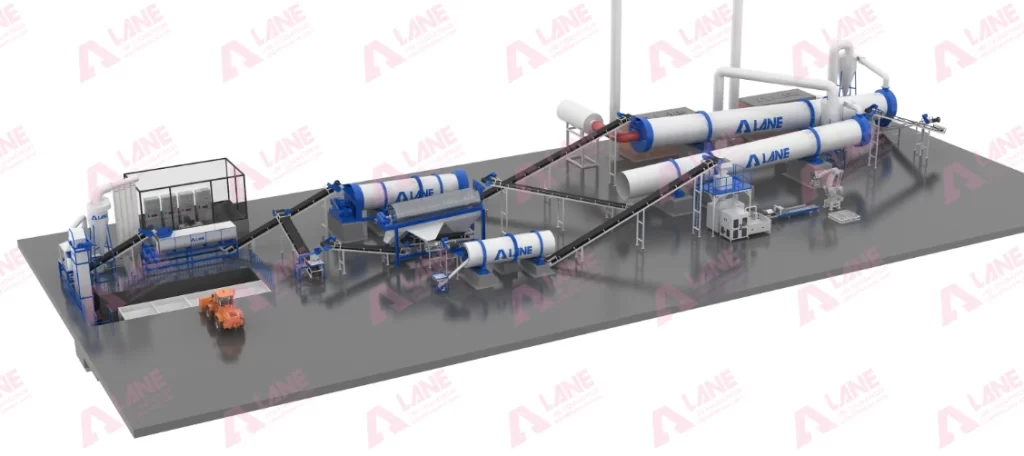
For those sourcing fertilizers from commercial manufacturers or evaluating production partners, understanding the machinery involved helps you ask the right questions about product quality and consistency. The core equipment in a granular mineral fertilizer for fruit trees production line includes:
- Rotary drum granulator— the primary granulation unit, critical for producing uniform, dense granules with consistent NPK distribution
- Raymond mill— used for grinding raw mineral inputs like phosphate rock or potassium ore to required particle fineness
- Double shaft mixer— ensures homogeneous blending of multi-nutrient compounds before granulation
- Rotary Drum Dryer and Cooler— Removes excess moisture and reduces product temperature after granulation to improve storability and prevent caking during bagging.
- Vibrating screen— classifies granules by size, separating off-spec material for rework
- Belt conveyor— connects process stages and ensures continuous, controlled material flow
- Bag filter / dust collector— manages particulate emissions across the line, essential for both compliance and raw material recovery
Large fertilizer equipment manufacturers like LANE, whose products are sold globally, specialize in designing production lines for compound fertilizers, including orchard-specific formulations. Based on my on-site observations, the granulation and drying stages are crucial in determining product performance.
How to Apply Mineral Fertilizer for Fruit Trees Effectively
Timing and placement matter as much as the formula itself. Broadcasting on the soil surface without incorporation is, honestly, one of the most common and most wasteful approaches I’ve encountered. Phosphorus, in particular, has almost no mobility in most orchard soils. It needs to be placed where roots can actually reach it.
For mature trees, fertigation — delivering soluble mineral formulations through drip irrigation systems — has become the benchmark in high-intensity production. It allows split applications that match the tree’s uptake curve rather than dumping a season’s worth of fruit tree nutrients in one shot.
Soil testing before the season and tissue sampling mid-season are not optional if you’re serious about precision. They’re the difference between guessing and knowing.
Summary
Applying the right mineral fertilizer for fruit trees isn’t complicated, but it does require discipline — in timing, placement, formulation, and monitoring. Getting fruit tree nutrients right across the growing season is what separates average yields from exceptional ones. Nitrogen, potassium, calcium, and phosphorus each have a defined role, and sequencing them correctly is the real skill.
If you’re a fertilizer producer looking to expand into specialty tree crop formulations, or an equipment buyer evaluating production line capabilities, LANE’s engineering team can help you assess your technical requirements and specify the right machinery configuration.
Contact us today to discuss your production needs.
FAQ: Mineral Fertilizer for Fruit Trees
Q1: What is the best mineral fertilizer for fruit trees at the start of the growing season?
High-nitrogen formulations — commonly ammonium sulfate or urea-based compounds — are most effective at bud break. They support rapid vegetative growth before shifting to balanced NPK for fruit development.
Q2: How often should mineral fertilizer for fruit trees be applied across the season?
Split applications consistently outperform single large doses. Most commercial orchards apply three to five times annually, aligned with key phenological stages: bud break, fruit set, cell division, pre-harvest, and post-harvest.
Q3: Can too much mineral fertilizer harm fruit trees?
Yes. Nitrogen excess in late summer delays ripening and increases disease susceptibility. Potassium over-application can antagonize calcium and magnesium uptake, triggering deficiency symptoms despite adequate soil levels.
Q4: What fruit tree nutrients are most critical for fruit quality?
Potassium and calcium are the primary quality-determining fruit tree nutrients. Potassium governs sugar loading and color; calcium determines cell wall integrity, firmness, and post-harvest shelf life.
Q5: Is foliar application of mineral fertilizer effective for fruit trees?
For calcium and certain micronutrients, foliar delivery is actually more effective than soil application due to slow soil mobility and root competition. Boron, zinc, and manganese are commonly delivered this way in commercial orchards.
Q6: How does granule quality from the production line affect field performance?
Granule uniformity, hardness, and moisture content directly influence dissolution rate and nutrient release behavior. Poorly granulated or under-dried product can cake in storage, distribute unevenly during application, and deliver inconsistent availability of essential nutrients — all of which hurt the grower’s results downstream.

For more details, please feel free to contact us.
Henan Lane Heavy Industry Machinery Technology Co., Ltd.
Email: sales@lanesvc.com
Contact number: +86 13526470520
Whatsapp: +86 13526470520


Send a message to us