


Fertilizer Factory Investment Guide: How to Underwrite a Plant Before You Sign
Every fertilizer project looks viable in the pitch deck. The numbers that decide it sit in three places investors check last: the grade you can sell at a premium, the feedstock contract you can secure, and the working capital you need before the first invoice clears.
This fertilizer factory investment guide follows the order we use when a client asks for a budget: define the product, pick the route, cost the whole project, clear the permits, then test the operating model at a utilization rate you can defend.
Start with the grade, not the machine
A fertilizer factory sells a commodity with a brand wrapped around it. Your ceiling is import parity, what a distributor pays for the same grade landed from a regional producer. The floor is your cash cost per ton. The distance between those lines is margin, and it depends more on product choice than on how modern the granulator is.
Commodity grades such as 15-15-15 compete on price and logistics. Specialty grades, say 12-32-16 with zinc or 15-15-15 plus 5 percent sulfur, sell at a premium because they solve a specific soil or crop problem. The premium is real, and so is the batching accuracy needed to hit those grades consistently.
Any fertilizer factory investment guide that opens with equipment gets the order wrong. Start with soil tests for your target districts, the application equipment farmers own, and the grade mix distributors already stock. 4R nutrient stewardship programs, which match source, rate, timing, and placement to crop need, show where demand is heading.
Then run one test. Can you pre-sell 60 to 70 percent of year-one output before construction starts? If not, no machine fixes the problem.
Choose the route before you request quotations
Suppliers quote what you ask for. Ask for a granulation line before comparing routes, and you never learn that a blending plant could have served the same market for a third of the capital.
| Route | Feedstock | Scale | Capital | Product |
|---|---|---|---|---|
| Drum granulation | Urea, DAP or MAP, MOP, filler | 3 to 20 TPH | Medium to high | Round, hard granules; wide formula range |
| Bulk blending | Granular straight fertilizers | 5 to 30 TPH | Low | Physical mixture; segregation risk |
| SSP or TSP | Phosphate rock plus acid | 5 to 20 TPH | Medium | Single-nutrient P, lower analysis |
| Organic granulation | Manure, compost | 1 to 10 TPH | Low to medium | Certified organic markets |
Drum granulation handles the widest formulation range and produces granules that survive transport and spreaders. Recycle ratios of 0.5:1 to 1:1 push the crusher, dryer, and cooler above the fresh feed rate, which is where much of the capital goes.
Bulk blending costs far less. You buy granular urea, DAP, and MOP, weigh, and mix. No dryer, no steam, no granulator. The weakness is segregation: a truckload separates by size and density, so a farmer can spread an uneven load.
SSP and TSP lines serve a different buyer. They make a phosphate-only product from rock and acid, which suits regions with cheap local rock and phosphorus as the limiting nutrient. The chemistry is less forgiving and permitting is heavier.
Organic granulation is the lowest-capital entry, but it depends on certification, feedstock consistency, and a market that pays for organic inputs.
A blending plant can be a deliberate first phase. Retrofitting it into a fertilizer production line later usually means new foundations, a taller building, and a different utilities package. If the five-year plan includes granulation, buy a site that can take it.
Fertilizer plant cost: what the quotation leaves out
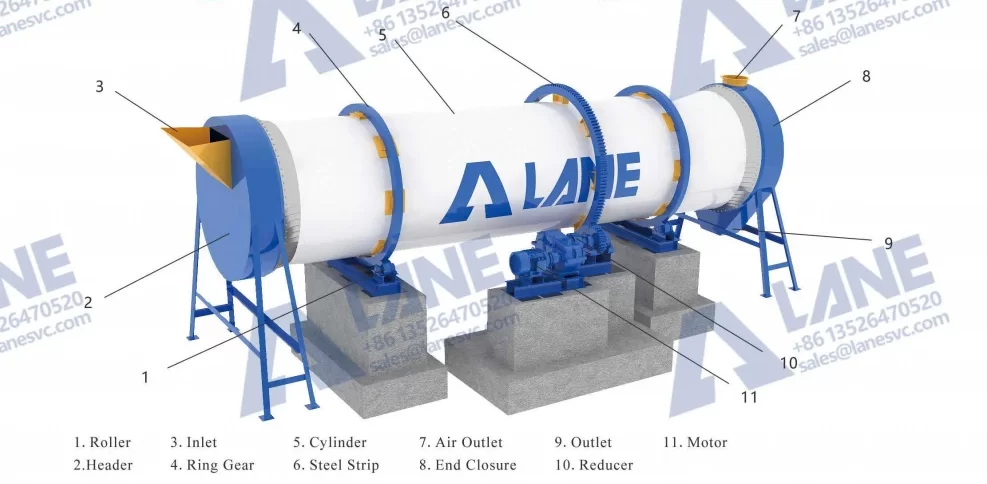
Equipment runs 55 to 65 percent of fertilizer plant cost on a complete fertilizer production line. Installation takes 15 to 20 percent, civil works 12 to 18 percent, and commissioning, training, and the initial spare parts package absorb the rest.Equipment’s share falls as capacity rises, because civils scale more slowly than machinery.
Those ranges still leave out what sinks first-time investors.
Working capital is the biggest omission. You need 60 to 90 days of raw material inventory, finished goods ahead of the planting season, and 30 to 45 days of receivables. On a 5 TPH fertilizer production line that can exceed the equipment budget in year one.
Site infrastructure is the second fertilizer plant cost omission. A greenfield site needs a substation, water, compressed air, drainage, a weighbridge, covered raw material bays, and a finished goods warehouse. Extending the grid alone can reach 5 to 8 percent of capital cost.
Add the laboratory, the maintenance workshop, and a contingency of 10 to 15 percent. A fertilizer plant cost estimate without those lines is a quotation, not a budget. Two reference pages go deeper: our fertilizer manufacturing plant cost breakdown and the capacity comparison for NPK production lines.
Permits, product registration, and standards
Registration is the schedule risk that surprises investors most, because it runs on a regulator’s calendar rather than yours.
Most markets require each grade to be registered with a guaranteed nutrient analysis, and the label is a legal commitment. Heavy metal limits, biuret content in urea-based products, and moisture get tested at the border or the factory gate. In the European Union, Regulation (EU) 2019/1009 sets harmonized rules for fertilising products and requires conformity assessment before a product carries the CE mark.
Environmental permits cover dust from the dryer and cooler, combustion emissions, scrubber wash water, and noise. The World Bank Group’s Environmental, Health, and Safety Guidelines for Fertilizer Production is a reasonable baseline for what regulators expect.
ISO 9001 is not legally required, but public tenders increasingly ask for it. Build the quality system while the plant is being erected, not after the first rejected shipment.
Start registration alongside detailed engineering. A three to nine month window is common, and a delayed shipment is easier to explain than a plant that cannot legally sell its product.
The operating model that decides payback
Raw materials account for 70 to 80 percent of production cost per ton. That ratio explains most of the gap between a plant that pays back in three years and one that never does, because there is little room to recover a formulation error or a bad purchasing decision.
Energy runs 5 to 10 percent, labor 3 to 6 percent, maintenance 3 to 5 percent of equipment capital per year, and bags 1 to 2 percent. What remains services debt.
Utilization is the variable most overstated in any fertilizer manufacturing business plan. Model year one at 65 to 75 percent of nameplate and steady state at 85 percent. A 5 TPH fertilizer production line at 70 percent utilization makes roughly 8,400 tons a year on a 300-day, single-shift basis. At 90 percent it makes about 10,800 tons. The difference in contribution margin usually exceeds the maintenance budget.
Payback of three to five years is realistic for a granulation line with local feedstock and a distribution radius under 200 km.
The cash cycle matters as much as the income statement. Demand is seasonal, so you build inventory before planting and collect after harvest. A fertilizer manufacturing business plan showing a healthy annual profit and a negative cash balance in month seven is not a contradiction. It is a working capital plan that was never written.
Choosing the supplier and the contract
A turnkey supplier takes responsibility for process, equipment, and usually installation. Multiple vendors split mechanical, electrical, and civil scope and leave integration to you. An EPC contractor bundles everything, including buildings, and charges for coordination.
For a first plant, turnkey removes the most integration risk, provided the scope boundary for the fertilizer production line is written down. Most disputes start at the conveyor that nobody quoted.
Ask for six documents before signing: a mass and energy balance, a utility table, a general arrangement drawing, a factory acceptance test protocol, a performance test procedure with guaranteed values, and a spare parts list with lead times. The test should state capacity at a given formula, granule size distribution, hardness, and moisture. Without those four numbers, a guaranteed capacity figure is a marketing phrase.
Check references at your capacity and feedstock. A supplier with twenty 2 TPH disc lines may never have commissioned a 15 TPH drum fertilizer production line.
Payment terms should follow milestones: design approval, factory acceptance test, shipment, mechanical completion, performance test, and warranty retention.
Where projects go wrong
These failures come up often enough in our project reviews to belong in any fertilizer factory investment guide.
Crusher sizing often assumes fresh feed instead of total throughput, so the recycle loop backs up within a month and the granulator starves for fines.
Dryer L/D gets specified for a dry climate, then installed at a coastal site where humidity holds above 70 percent.
The batching system has six hoppers because year-one formulas need six, while the roadmap needs ten.
The plant opens with twelve SKUs to look established, spreads changeover time across all of them, and never runs a campaign long enough to stabilize granulation.
Pre-investment checklist
| Gate | Question | Evidence |
|---|---|---|
| Market | Can you pre-sell 60 to 70 percent of year-one output? | Distributor letters of intent |
| Feedstock | Is supply contracted at a landed cost that leaves margin at import parity? | Supply agreements, freight quotes |
| Route | Does the process match the grades and volumes you can sell? | Route comparison with capex and opex |
| Capital | Is the fertilizer plant cost model complete and funded? | Cash flow model covering 18 months |
| Compliance | Can each grade be registered and the plant permitted? | Regulator feedback, permit timeline |
| Supplier | Is the fertilizer production line scope complete and the test defined? | Mass balance, GA drawing, test protocol |
FAQ
How much does it cost to build a fertilizer factory?
The typical fertilizer plant cost runs from about USD 90,000 at 1 TPH to USD 2.0 million at 20 TPH, including equipment, installation, civils, and commissioning. Working capital and site infrastructure usually add 30 to 50 percent.
How long does it take to build and commission?
A 5 TPH line in an existing building takes 8 to 14 weeks from equipment arrival to first production, and 5 to 8 months from purchase order. Greenfield sites add 3 to 6 months.
What is the minimum viable capacity?
One to two tons per hour is the practical floor for a commercial fertilizer production line. Below that, labor and overhead per ton rise faster than margin.
Do I need a fertilizer manufacturing business plan to raise financing?
Banks and development finance institutions expect one, and they test assumptions. Feedstock contracts, offtake evidence, the utilization ramp, and the working capital schedule matter most.
Which grade is most profitable?
Specialty grades with micronutrients carry the widest margin, but they demand tighter batching tolerance and a market willing to pay. Most plants run a mix and let specialty lines carry fixed costs.
Can I start with blending and upgrade to granulation later?
Yes, and many operators do. Plan the site for the upgrade, because building height, foundation loads, and utilities are expensive to change.
What raw materials do I need?
For NPK: urea or ammonium sulfate for nitrogen, DAP or MAP for phosphorus, MOP or SOP for potassium, plus fillers and micronutrients. Raw materials are 70 to 80 percent of production cost.
How do I verify a supplier’s claimed experience?
Ask for commissioning reports from three fertilizer production lines at your capacity and feedstock, then call those customers. A video of a running plant is not a performance test.

Send a message to us