


How a Compound Fertilizer Granulation Machine Works & Cost
If you’ve ever walked through a large fertilizer production facility, you know the granulation stage is where everything comes together. The compound fertilizer granulation machine is where powder blends are transformed into the uniform, market-ready granules that producers ship worldwide. And yet, for many investors and plant managers, this equipment category remains surprisingly misunderstood. Let me break it down.
What Does a Compound Fertilizer Granulation Machine Actually Do?
A compound fertilizer granulation machine binds multiple nutrient inputs — nitrogen, phosphorus, and potassium — into cohesive granules of a specific size and hardness. This isn’t simply mixing and pressing. There are moisture dynamics to manage, particle size distribution to control, and in some cases, mild chemical reactions taking place simultaneously. Getting it wrong means brittle granules that crumble during transport and uneven nutrient release in the field. Getting it right means consistent product quality and a real competitive edge.
Most commercial-grade machines process between 5 and 50 metric tons per hour. Temperature, feed rate, binder content, and drum speed all interact in ways experienced operators learn to read instinctively. From what I’ve seen in the field, the biggest production headaches rarely come from mechanical failure — they come from operators who don’t fully understand how those variables interconnect.
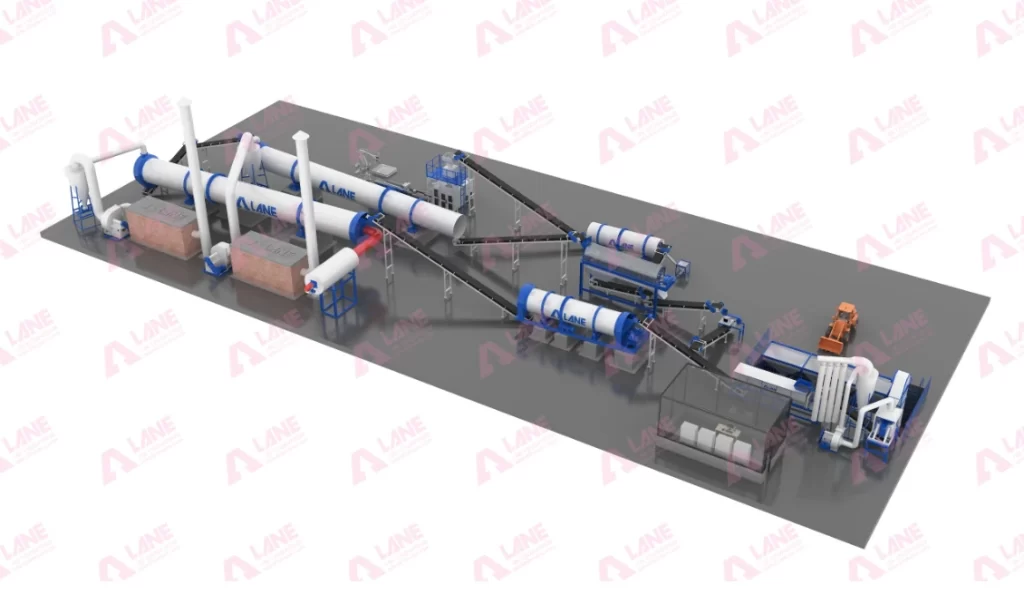
Core Equipment in a Granulation Production Line
No compound fertilizer granulation machine operates in isolation. The granulator sits at the center, but the surrounding equipment is just as critical. Here are the standard units in any well-engineered line:
- Rotary drum granulator:The workhorse of large-capacity NPK production. Raw materials tumble inside a rotating drum while liquid binders are sprayed in, forming granules through agglomeration. High throughput, manageable maintenance. Most industrial plants run this type.
- Disc granulator:Preferred for smaller batches or specialty formulas. Gives operators real-time control over granule size, making it well-suited for organic-NPK blends.
- Double shaft mixer:Pre-conditions raw powders before granulation, ensuring uniform moisture distribution. Skipping this step is a shortcut that almost always causes downstream problems.
- Rotary drum dryer:Removes excess moisture post-granulation. Moisture above 2% in the finished granule typically causes caking during storage — this unit is non-negotiable.
- Rotary drum cooler:Drops granule temperature before screening. Hot granules deform under conveyor and packaging pressure.
- Vibrating screen:Separates on-spec granules from oversized and undersized material. Both fractions are recycled back into the process.
- Coating machine:Applies anti-caking agents or slow-release coatings to finished granules.
- Belt conveyor system:Connects every unit. Poor conveyor design is a more common bottleneck than most buyers expect.
- Automatic packaging machine:Closes the loop with weighing, filling, and sealing — typically in 25 to 50 kg bags.
How the Granulation Process Works
Raw materials — urea, MAP, MOP, ammonium sulfate, and various fillers — are batched by formula and blended in the double shaft mixer. Steam or liquid binder is introduced to reach the target inlet moisture, typically 20–30%.
Inside the compound fertilizer granulation machine, material tumbles continuously. The rotating action causes particles to collide, adhere, and grow. Temperature control is critical here. Too cold, and particles won’t bond properly. Too hot, and you risk unwanted reactions — particularly ammonium volatilization in nitrogen-rich blends. Whether you’re running a rotary drum type or a disc-based NPK fertilizer granulator, the principles are the same, but the operating parameters differ meaningfully.
After granulation, wet granules pass through the rotary drum dryer, operating between 80°C and 200°C depending on product sensitivity, then through the rotary drum cooler and vibrating screen. On-spec material moves to coating and packaging. The rest recycles. To be honest, the elegance of a well-tuned line is something you only appreciate after watching a poorly calibrated one struggle through a shift.
What Does a Compound Fertilizer Granulation Machine Cost?
Everyone asks this eventually when evaluating a compound fertilizer granulation machine investment, and the honest answer is: it depends — but here are realistic benchmarks.
A standalone compound fertilizer granulation machine ranges from roughly $15,000 USD for an entry-level disc unit to $120,000 or more for a large-capacity rotary drum system with drives and sealing fully included. For complete production lines, expect:
- 5–10 t/h complete line: $200,000 – $500,000 USD
- 15–30 t/h complete line: $500,000 – $1,200,000 USD
- 30–50 t/h complete line: $1,200,000 – $3,000,000+ USD
These figures cover equipment, installation guidance, and commissioning support — not civil construction or utility infrastructure. Freight, import duties, and local electrical work add further cost.
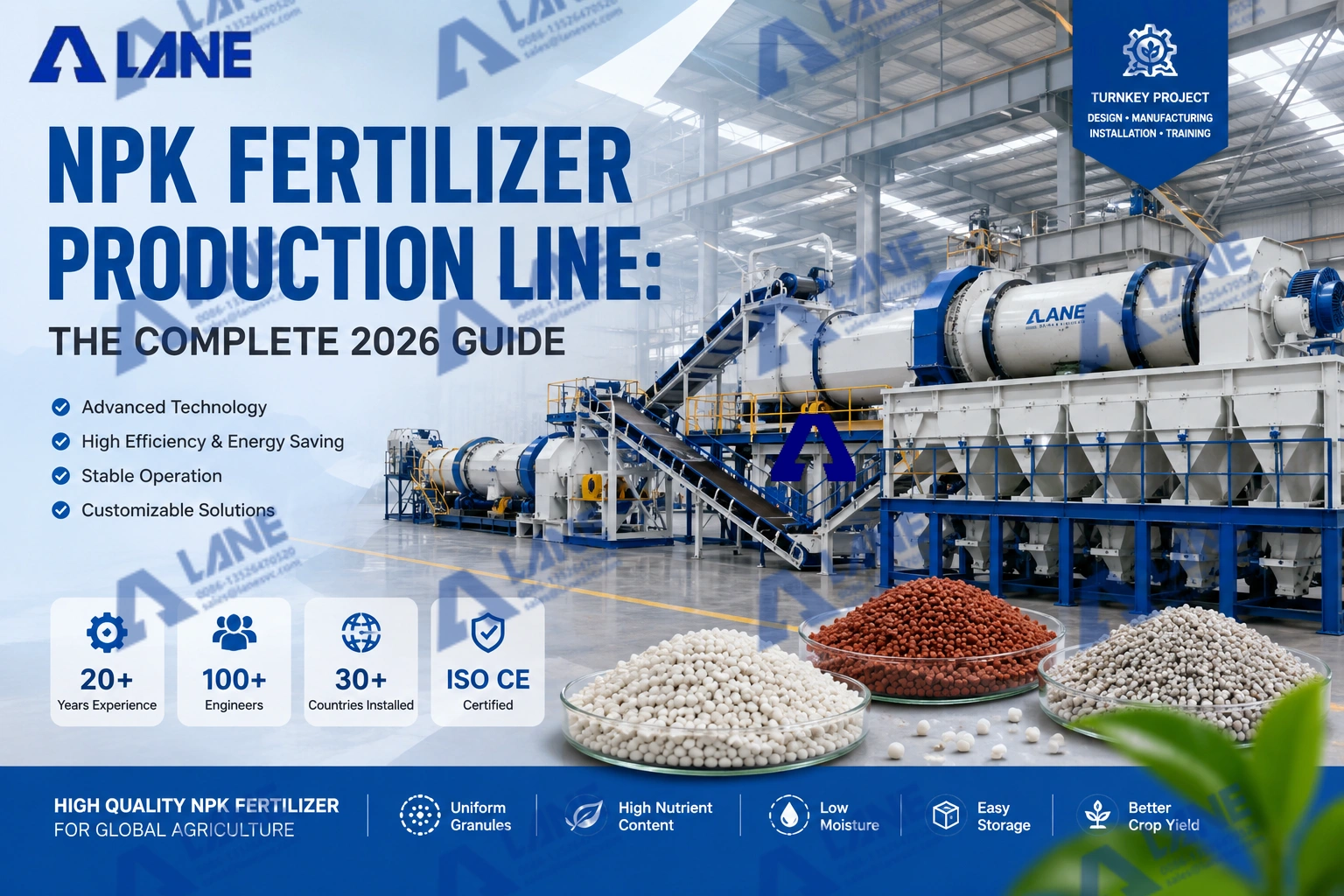
Manufacturers like LANE, which specializes in large-scale fertilizer production equipment, offer full turnkey line solutions with process engineering support included. For buyers in Africa, Southeast Asia, or the Middle East — markets where local engineering resources may be limited — that bundled technical support carries real value beyond the equipment itself.
Key Factors That Affect ROI
Granule quality directly affects your selling price. Invest in proper drying and screening capacity upfront rather than retrofitting later. Energy consumption is the largest ongoing operating cost — specifically the dryer. Natural gas-fired systems run significantly cheaper per ton than diesel-fired units in most markets.
Spare parts availability is something producers in emerging markets routinely overlook. Ask your supplier explicitly about local parts access before signing. This one point has derailed more investments than I care to count.
Final Thoughts and Next Steps
A compound fertilizer granulation machine is the centerpiece of a production system that must be designed and sized as a whole. Understanding how the NPK fertilizer granulator and its surrounding units interact gives you leverage — smarter procurement decisions, better supplier negotiations, and fewer costly commissioning surprises.
If you’re at the feasibility or investment stage, engage a supplier with demonstrated large-scale project experience early. Share your target NPK formula, annual production goal, and energy infrastructure. Expect detailed process flow proposals in return, not just equipment catalogs. LANE’s engineering team provides exactly that level of pre-sale technical depth for serious buyers.
Ready to get specific numbers for your project? Contact us for a customized line plan and itemized quotation.
FAQ
Q1: What is the difference between a rotary drum granulator and a disc granulator for NPK production?
A rotary drum granulator handles much higher throughput — typically 5 to 30+ t/h — making it standard for industrial-scale NPK lines. The disc granulator suits smaller batches and offers more granule size control. For any compound fertilizer granulation machine selection, your annual tonnage target is the deciding factor. Producers above 50,000 metric tons almost always run drum-type systems.
Q2: What NPK formulas can a compound fertilizer granulation machine process?
Most lines accommodate a wide range of NPK ratios — 15-15-15, 17-17-17, 20-10-10, and custom blends. A well-configured NPK fertilizer granulator with adjustable binder dosing handles most standard agricultural formulas without major equipment changes. Matching the NPK fertilizer granulator type to your specific raw material mix is critical to achieving stable output quality.
Q3: How long does commissioning take for a new granulation line?
Equipment delivery takes 60 to 120 days depending on complexity. On-site installation and commissioning adds 30 to 60 days, assuming civil works are complete. Budget 4 to 6 months from contract signing to first saleable output — treat that as the optimistic scenario.
Q4: What routine maintenance does a granulation machine require?
For any compound fertilizer granulation machine, focus on lubrication of rotating components, drum lining inspection, and spray nozzle cleaning. Vibrating screen decks and bag filter media need periodic replacement. A well-maintained rotary drum granulator should run 8,000 to 10,000 operating hours between major overhauls.
Q5: Can a compound fertilizer granulation machine handle organic-mineral blends?
Yes, with specific calibration. Organic inputs introduce higher moisture content and variable particle size that require careful process adjustment. Some producers run dedicated lines for organic-mineral products to avoid formula changeover downtime and cross-contamination risk.
Q6: What is the typical energy consumption of a granulation line?
The dryer accounts for 40 to 60% of total line energy use. A 10 t/h natural gas-fired line typically consumes 80 to 120 cubic meters of gas per ton of product. Granulator drives add 15 to 30 kWh per ton depending on material hardness and target granule size.
For more details, please feel free to contact us.
Henan Lane Heavy Industry Machinery Technology Co., Ltd.
Email: sales@lanesvc.com
Contact number: +86 13526470520
Whatsapp: +86 13526470520

Send a message to us