


TSP Production Line Turnkey Solutions: How to Plan, Cost, and Commission a Triple Superphosphate Plant
Triple superphosphate (TSP) delivers concentrated phosphorus with no nitrogen. If you are comparing TSP production line turnkey solutions, the chemistry is the easy part. What decides whether the project earns money is scope definition, process configuration, cost structure, commissioning, and who is accountable when the first granule leaves the cooler off specification.
This guide is for the people who sign off on those decisions: fertilizer manufacturers adding capacity, plant investors, process engineers who will run the line, procurement managers comparing quotations, and EPC contractors evaluating suppliers.
- Turnkey normally means process design, equipment, erection supervision, commissioning, and training under one contract; civil works, site utilities, and raw materials stay with the owner.
- TSP is made by acidulating phosphate rock with phosphoric acid. No ammonia is involved.
- Delivered acid cost per metric ton of P2O5 and plant utilization drive economics more than equipment selection.
What Turnkey Covers in a TSP Project, and Where the Scope Usually Ends
Turnkey is the most loosely used term in fertilizer equipment sales, and two quotes labeled complete can differ by entire plant sections. Before comparing prices on a turnkey fertilizer plant, write down the scope and price every supplier against the same list.
A turnkey TSP production line normally bundles the design basis, mass balance, P&IDs, equipment fabrication, shipping, erection supervision, commissioning, operator training, and a performance test.
Outside that battery limit sit civil construction, site utilities, acid storage, laboratory setup, duty and inland transport, and working capital for the first rock and acid inventory. Price those separately even if a local contractor executes them.
Four questions expose a thin scope: Which rock analysis does the guarantee assume? At what capacity, moisture, and granule size is it measured? Which spare parts ship with the line? How many commissioning engineer-days are included?
How TSP Is Made: Process Flow from Rock to Bagged Granule
Reaction chemistry
A triple superphosphate production line acidulates finely ground phosphate rock with phosphoric acid. In fertilizer manufacturing, TSP means triple superphosphate, not the sodium tripolyphosphate sold to detergent makers. Using fluorapatite as the reference mineral:
Ca5(PO4)3F + 7 H3PO4 → 5 Ca(H2PO4)2·H2O + HF
The product is monocalcium phosphate monohydrate, which is why TSP trades as a nominal 0-46-0 grade. The reaction is fast, exothermic, and releases fluoride gas that must be scrubbed. With no ammonia involved, the plant is simpler to permit than MAP or DAP, but acid supply becomes the project’s largest cost and logistics exposure.
Process steps
- Rock grinding. Ring-roller or ball mills reduce rock to a fine powder; reaction rate depends on surface area, and fineness sets mill wear.
- Acidulation. Metered phosphoric acid, typically 50–54% P2O5, is blended with ground rock in a mixer or pugmill at an acid-to-rock ratio near stoichiometric.
- Curing. Material discharges to a den or curing pile while free acid and moisture fall and P2O5 availability stabilizes.
- Granulation. Cured material is granulated in a rotary drum or pugmill with water and often steam.
- Drying and cooling. A rotary dryer brings moisture down to roughly 2%, then a rotary cooler returns material near ambient before screening.
- Screening. Product is cut to the band your market wants, commonly 1–4 mm; oversize and fines recycle.
- Coating. Oil, wax, or clay treatment where humid storage or blending requires it.
- Storage and bagging. Silo for bulk, bagging line for 50 kg or jumbo bags.
Control parameters that decide product quality
Daily control comes down to acid concentration and dosing accuracy, mixer retention, cure time, granulator liquid-to-solid ratio, recycle ratio, and dryer temperature. Over-drying is the expensive mistake: excess heat pushes water-soluble P2O5 into citrate-soluble or insoluble forms, lowering agronomic value and risking a specification breach.
Equipment Composition of a Complete Triple Superphosphate Production Line
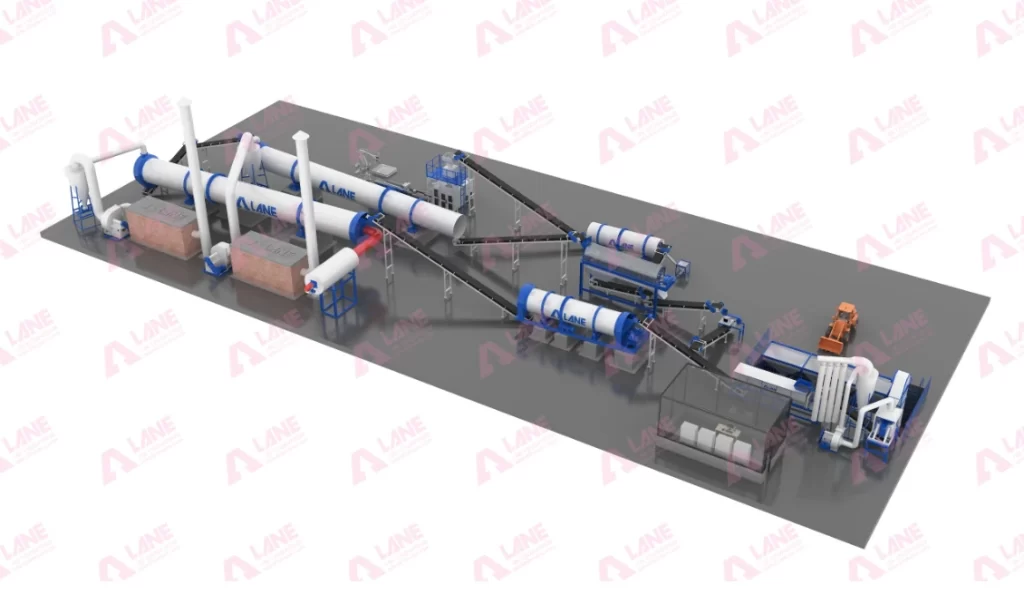
Reaction and curing: rock hopper and weigh feeder, ring-roller mill with classifier, acid day tank with metering pumps and flow instruments, continuous mixer with replaceable blades and liners, and the curing den. Acid-wetted parts need correct alloy or lining.
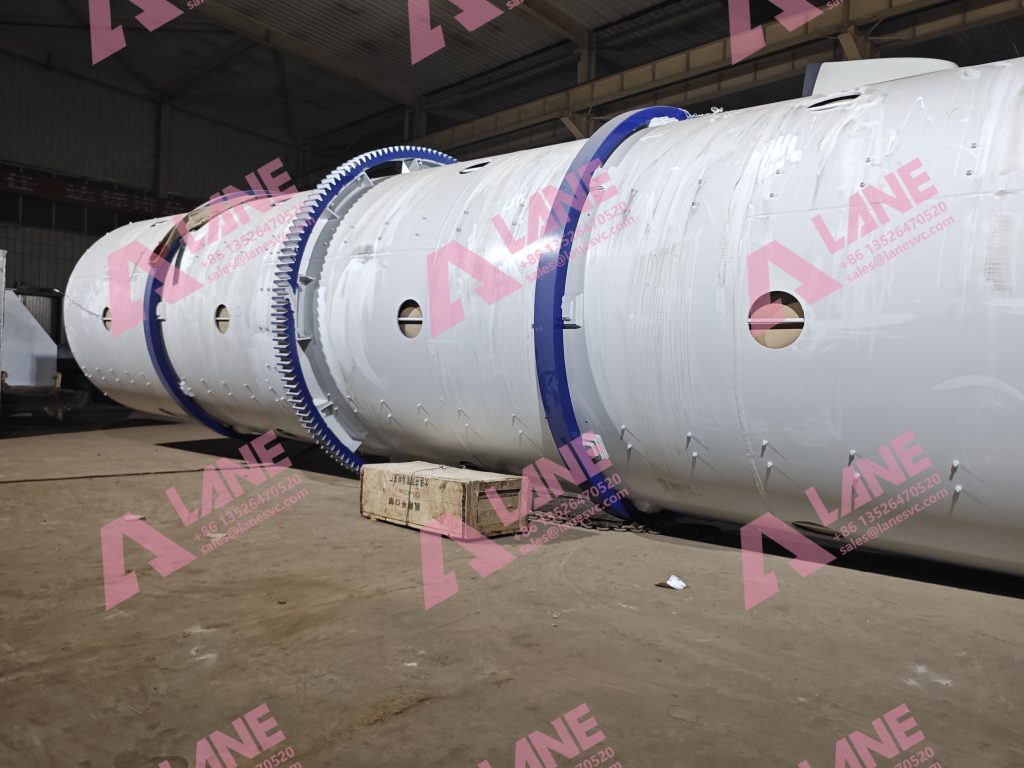
Granulation, drying, cooling: drum granulator with rubber lining and scraper, recycle weigh belt, co-current rotary dryer with internal flights, burner, rotary cooler, and exhaust cleaning.
Sizing and recycle: bucket elevators, conveyors, double-deck vibrating screens, a chain mill or roll crusher for oversize, and dust-return lines sized for upset conditions.
Product handling: coating drum with dosing pump, storage silo, bagging machine, dust hoods at transfer points, and a PLC/HMI with interlocks.
TSP, SSP, MAP, and DAP: Choosing the Phosphate Route
| Product | Nominal analysis | Main acid | Ammonia needed | Where it fits |
|---|---|---|---|---|
| SSP (single superphosphate) | 0-16-0 to 0-20-0 | Sulfuric acid | No | Low-analysis markets where sulfuric acid is cheap and local; supplies sulfur and calcium |
| TSP (triple superphosphate) | 0-46-0 | Phosphoric acid | No | Highest P2O5 per metric ton of freight; blending markets and direct application on acidic soils |
| MAP (monoammonium phosphate) | 11-52-0 | Phosphoric acid | Yes | High-analysis blends where nitrogen in the granule is acceptable |
| DAP (diammonium phosphate) | 18-46-0 | Phosphoric acid | Yes | Large nitrogen-phosphorus markets with ammonia infrastructure |
TSP and SSP avoid ammonia storage and refrigeration, which keeps the plant simpler. The trade-off is acid cost and freight. TSP concentrates more P2O5 per metric ton shipped, so a triple superphosphate (TSP) production line remains a standard choice for producers who buy acid instead of making it. Two market trends keep the category active: buyers in import-dependent markets are adding local phosphorus capacity, and rock sourcing must now clear cadmium limits in regulated markets such as the EU.
Feasibility Inputs: Rock, Acid, Utilities, and Site
Phosphate rock. Total P2O5 or BPL, the CaO to P2O5 ratio, iron and aluminum, carbonate and MgO levels, fluorine, hardness, and fines all change the design. Iron and aluminum consume acid and push P2O5 out of water-soluble form; fluorine sets the scrubber load.
Phosphoric acid. P2O5 concentration, sulfate and impurities, storage materials, and above all delivered cost per metric ton of P2O5.
Utilities. Fuel for drying, power for grinding and fans, water for granulation and scrubbing, and compressed air.
Site. Acid containment and drainage, wind direction relative to housing, humid or coastal climate, transport access, and skilled labor. Two numbers settle feasibility faster than any equipment choice: delivered acid cost per unit of P2O5 and realistic utilization.
What Drives the Cost of a TSP Plant Project
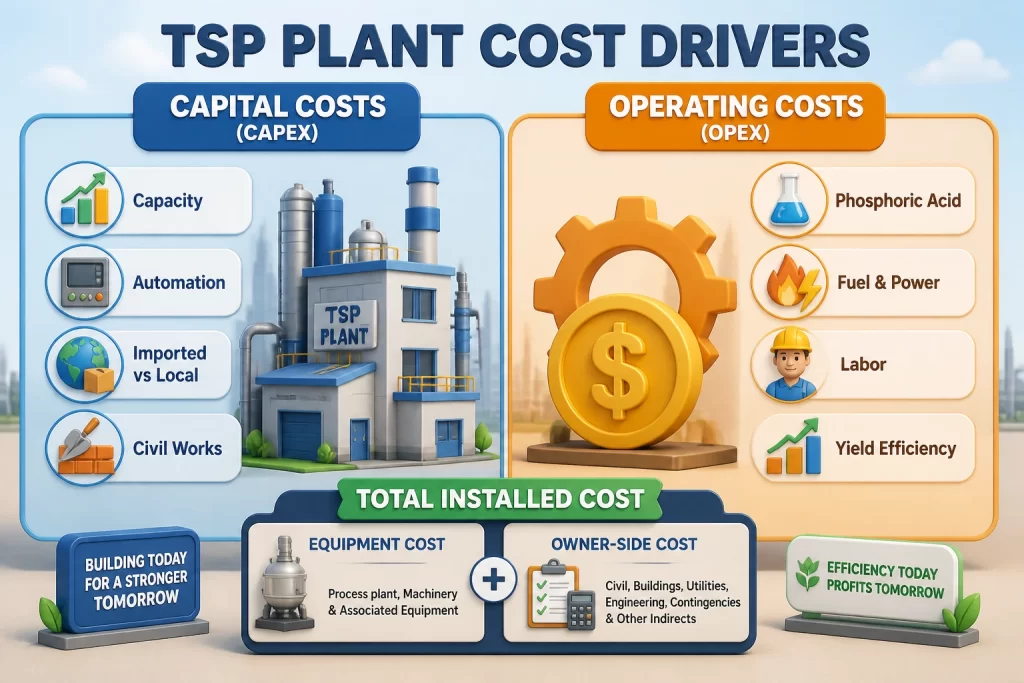
Capital cost drivers: capacity in metric tons per day, product form, grinding fineness, automation, materials of construction in acid service, fuel and burner choice, emissions control, layout, imported versus locally fabricated equipment, freight and duty, and spare parts. Inside a turnkey TSP production line, equipment is usually the largest block, but owner-side costs are routinely underestimated: civil works, land, utility connections, warehouse, and working capital. Compare total installed cost, not equipment price: a quotation that shifts civil, electrical, and acid handling onto you is not cheaper.
Operating cost drivers, in order: phosphoric acid, rock, drying fuel, power, labor, maintenance and wear parts, packaging, and financing. Yield losses from dust carryover, off-spec product, and excess recycle show up as unit cost, which is why commissioning quality matters financially.
Powder TSP or Granular TSP?
Product form is the first decision in most TSP production line turnkey solutions. Powder TSP leaving the curing section is saleable to blend plants, NPK compounders, and some direct-application markets. Capital cost is lower because drying, granulation, cooling, and most of the recycle loop are absent, but powder raises dust, cakes in storage, and spreads poorly.
Granular TSP matches the physical form of urea, MOP, and DAP, so it blends predictably and survives long-distance handling. The cost is extra capital, thermal energy, recycle load, and maintenance on more equipment. Many producers build powder first and leave room for a later granulation section.
Emissions, Safety, and Permit Considerations
Acidulation releases gaseous fluorides; grinding, drying, screening, and transfers generate phosphate dust. Both need capture and treatment: cyclones and bag filters for dust, a scrubber for fluoride gas. In the United States, the EPA New Source Performance Standards for triple superphosphate plants and granular TSP storage (40 CFR Part 60, Subparts W and X) are the reference for this equipment class, and most jurisdictions apply an equivalent regime.
Treat acid handling as the primary hazard: secondary containment, acid-resistant pumps, seals, and linings, eyewash and showers within reach, protective equipment, and scheduled inspections. Permits often set the critical path on a turnkey fertilizer plant, and lenders increasingly ask for ISO 14001 and ISO 45001 aligned management, which is cheaper to design in than to retrofit.
Maintenance Practices That Protect Uptime
Wear parts on a triple superphosphate line are predictable: mixer blades and liners, granulator lining and scraper, screw conveyor flights and hanger bearings, acid pump seals, chain mill hammers, screen decks, filter media, and dryer and cooler seals.
Critical spares at commissioning usually include mixer blades and liners, a granulator lining set, screen decks, an acid pump rebuild kit, and dryer seal components. Protect uptime with acid-line leak checks, lubrication routes, thickness checks on acid-wetted parts, and control loop calibration. Most capacity shortfalls on a triple superphosphate production line trace back to recycle balance and dust handling.
How to Vet a Turnkey Supplier
Most TSP production line turnkey solutions are won or lost on the questions asked before price is discussed. Ask any supplier pursuing a turnkey fertilizer plant award for:
- Design basis document and full equipment list with materials of construction
- How they will test your rock, including acidulation and curing trials rather than a generic rock assumption
- Reference plants with capacity, product form, and an operating contact
- Exact wording of the performance guarantee and the remedies attached to it
- P&IDs, datasheets, wiring diagrams, O&M manuals, spare parts book, and English training materials
- Quality records: material certificates, welding records, leak tests, and a factory acceptance test protocol you can witness
- Regional service, English-speaking commissioning engineers, and wear part lead times
A quotation without your rock analysis, a defined capacity basis, and materials of construction is not a quotation. It is a number that will change.
FAQ
What does a triple superphosphate production line turnkey solution include?
Process design, mass balance, P&IDs, equipment, shipping, erection supervision, commissioning, training, and a performance test. Civil works, utilities, acid storage, and raw materials stay with the owner.
How much does a turnkey fertilizer plant cost?
No universal figure exists: capacity, product form, rock quality, automation, and construction costs move the total widely. Compare total installed cost against an identical scope.
Can TSP be produced without ammonia?
Yes. TSP needs only phosphate rock and phosphoric acid, so there is no ammonia storage, refrigeration, or nitrogen handling, which simplifies permitting versus DAP or MAP.
How does TSP compare with SSP?
SSP uses sulfuric acid and lands near 16–20% P2O5 while supplying sulfur and calcium. TSP uses phosphoric acid, reaches about 46% P2O5, and cuts freight cost per unit of nutrient.
What raw materials and utilities does a TSP line need?
Ground phosphate rock, phosphoric acid, water and possibly steam for granulation, dryer fuel, power, and compressed air.
How long does it take to commission a TSP plant?
Lead time depends on acid supply, shipping, civil works, and permitting more than fabrication. Late civil completion and acid logistics cause most delays.
Which spare parts should we stock first?
Mixer blades and liners, a granulator lining set, screen decks, an acid pump rebuild kit, and dryer and cooler seal components. These cause the longest unplanned stoppages.
References and standards
- US EPA, 40 CFR Part 60 Subparts W and X: New Source Performance Standards for triple superphosphate plants and granular triple superphosphate storage facilities
- Regulation (EU) 2019/1009 on fertilising products: P2O5 declaration by solubility fraction and contaminant limits
- Association of American Plant Food Control Officials (AAPFCO): official fertilizer grade definitions, including nominal 0-46-0 TSP
- International Fertilizer Association (IFA) and The Fertilizer Institute (TFI): fertilizer supply, demand, and nutrient use data
- ISO 9001:2015, ISO 14001:2015, ISO 45001:2018: quality, environmental, and occupational health and safety management systems
- FAO soils and plant nutrition guidance: phosphorus behavior in soils and fertilizer management practice

Send a message to us