


Organic and Mineral Fertilizer Plant: What Buyers Need to Know Before Building
An organic and mineral fertilizer plant combines two nutrient systems in one production facility. It processes organic materials such as manure, compost, digestate, or crop residue, and blends them with mineral nutrients such as urea, ammonium phosphate, potassium sulfate, or micronutrient salts. The result is a product that delivers both soil organic matter and fast, predictable plant nutrition.
This guide is written for fertilizer manufacturers, plant investors, engineers, procurement managers, and project contractors. It covers the process and equipment scope, the decisions that drive cost, the difference between organic and organo-mineral products, and the supplier questions that protect a project from an incomplete quote.
Why integrated organic and mineral production is growing
The market for organo-mineral fertilizers has expanded because agriculture no longer treats organic and mineral inputs as an either-or decision. Mineral nutrients provide rapid availability, while organic matter supports soil structure, microbial activity, and long-term nutrient retention. An integrated plant can serve both needs in one product.
Regulation has made the category more visible. Regulation (EU) 2019/1009 defines an organo-mineral fertiliser as a co-formulation of one or more organic fertilisers and one or more inorganic fertilisers. That definition gives buyers a clear product framework for EU export projects.
New projects confirm the scale of the market. OMF Australia is constructing a 240,000 tons per year organic mineral fertiliser facility in Queensland, according to Queensland Government investment material. Kyrgyzstan also opened a new organomineral fertilizer plant with an initial line capacity of 100,000 tons per year, with plans to expand, according to industry reports. Those projects show that the concept is being built at industrial scale, beyond small pilot lines.
What an organic and mineral fertilizer plant produces
An organic and mineral fertilizer plant can produce several product families. The product range affects the equipment design, so it should be defined before the line is specified.
Organic fertilizer is made from plant, animal, or microbial material. It supplies organic matter and nutrients that become available as the material decomposes in soil. Production usually includes composting, crushing, mixing, granulation, drying, and packaging.
Mineral fertilizer
Mineral fertilizer is manufactured from concentrated inorganic nutrients. It provides immediate and predictable nutrition, and it is the base for NPK and other compound products. Production usually includes grinding, batching, mixing, granulation, drying, cooling, and packaging.
Organo-mineral fertilizer
Organo-mineral fertilizer is a co-formulation of organic and mineral components. It combines organic matter with concentrated mineral nutrients in one granule, powder, or liquid. Under Regulation (EU) 2019/1009, this product family is defined as a co-formulation of one or more organic fertilisers and one or more inorganic fertilisers.
For a buyer, the important distinction is that an organic and mineral fertilizer plant must be designed for both material streams. It needs a composting section for the organic feedstock, a mineral preparation section for batching and grinding, and a mixing and granulation section that can combine them without losing uniformity.
The organic mineral fertilizer manufacturing process step by step
The organic mineral fertilizer manufacturing process follows a sequence of biological and mechanical stages. Each stage changes the material for the next one.
Step 1: Receive and prepare the organic feedstock
Organic raw materials arrive with variable moisture, carbon-to-nitrogen ratio, and contaminant levels. High-moisture manure or digestate should pass through a screw press or inclined screen separator before composting. Large particles, stones, metal, and plastic must be removed at receiving.
Step 2: Compost or ferment the organic material
Aerobic composting stabilizes the organic fraction and reduces pathogens, weed seeds, and odors. Pile temperature should reach the 50 to 70 C range for a sustained period, and the active phase usually runs 15 to 25 days followed by curing.
The composting method affects capital and operating cost. Windrow systems need more land and labor. Trough and in-vessel systems give better process control and odor containment but carry higher equipment cost.
Step 3: Cure and dry the compost
After active composting, the material must cure so that immature organic acids and nitrogen hunger do not damage the final product. Curing can be followed by drying when the organic fraction needs to reach a moisture level that supports grinding and granulation.
Step 4: Grind and screen the organic fraction
Composted and dried organic material is ground to a consistent particle size. A crusher or mill breaks down clumps, and a screen removes oversize material. Particle size uniformity matters because it affects the final granule strength and nutrient distribution.
Step 5: Prepare and batch the mineral nutrients
Mineral raw materials are ground when needed, weighed, and dosed into the formulation. The batching system should be accurate because the final NPK grade depends on how precisely each nutrient is added.
Step 6: Mix the organic and mineral streams
The prepared organic powder and mineral nutrients are blended in an intensive mixer. The mixer must produce a uniform feed before granulation, because uneven mixing creates granules with different nutrient content.
Step 7: Granulate
Granulation converts the blended powder into uniform particles. Common options include:
- Rotary drum granulator for large continuous lines.
- Disc granulator for smaller capacity and tighter size control.
- Double roller or extrusion granulator for dry materials.
- New type organic fertilizer granulator for higher fiber content.
The choice depends on the moisture of the feed, the desired granule shape, and the amount of organic material in the formulation.
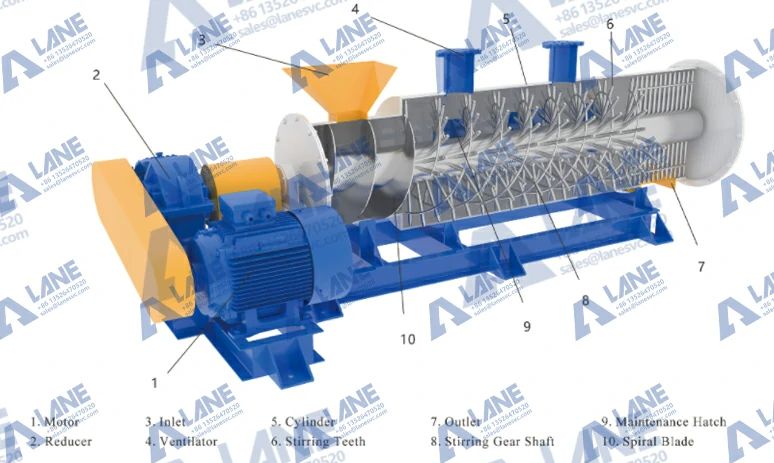
Wet granules are dried to a stable moisture level and then cooled before packaging. Drying consumes a large share of the plant’s energy, so the granulation route and the moisture target have a direct effect on operating cost.
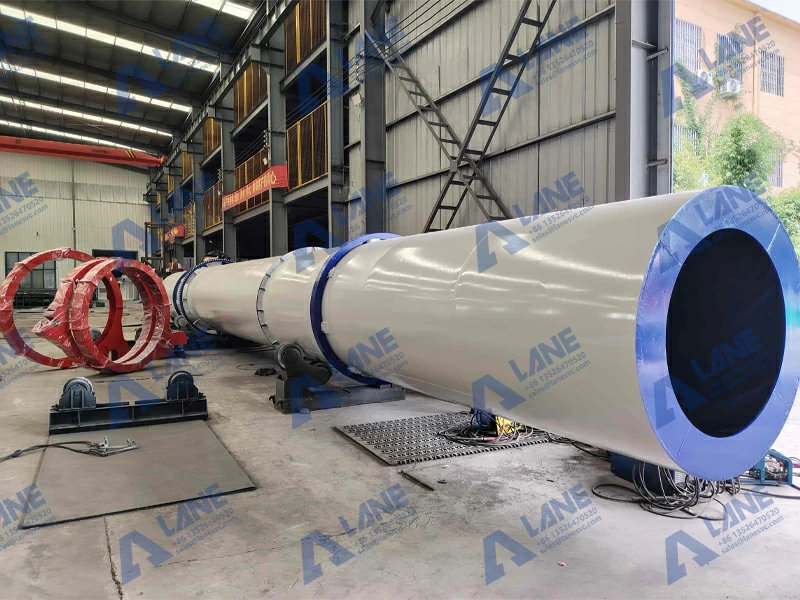
Step 9: Screen, coat, and package
The final screen removes oversize and undersize granules. Oversize material returns to the crusher, and fines return to the granulator. A coating machine can improve granule appearance and reduce dust. The automatic packaging machine records bag weight and keeps the line moving.
Organo-mineral fertilizer production line equipment
An organo-mineral fertilizer production line is an integrated equipment sequence, not a collection of individual machines. The complete line includes:
- Receiving and dewatering equipment: screw press, inclined screen separator, conveyor.
- Composting equipment: compost turner, trough system, fermentation tank, forced aeration.
- Curing and drying equipment: curing area, rotary dryer or belt dryer.
- Crushing and screening: chain crusher, semi-wet crusher, rotary screen.
- Mineral preparation: crusher, mill, batching scale, dosing system.
- Mixing: horizontal mixer, double shaft mixer, intensive mixer.
- Granulation: rotary drum granulator, disc granulator, double roller press, extrusion granulator.
- Drying and cooling: rotary drum dryer, rotary drum cooler, hot air furnace.
- Final processing: vibrating screen, coating machine, automatic packaging machine.
- Environmental controls: dust collection, odor control, leachate collection.
The equipment list should also include conveyors, bucket elevators, control cabinets, and instrumentation. A supplier that only quotes the granulator and dryer has not designed an organo-mineral fertilizer production line.
How the integrated process works
The integrated plant works as a moisture, particle-size, and nutrient pipeline.
The organic side starts with dewatering and composting, then moves through curing, grinding, and drying. The mineral side starts with grinding, batching, and dosing. The two streams meet in the mixer, where they become a uniform powder. The granulator shapes that powder into granules, and the dryer, cooler, and screen prepare it for packaging.
The organic mineral fertilizer manufacturing process depends on the moisture and particle size of each stream before they meet in the mixer.
Three variables control most of the operating result:
- Moisture at each transfer point.
- Particle size entering the mixer and granulator.
- Batching accuracy for the mineral nutrients.
When these are designed together, the line runs predictably. When equipment is bought piece by piece, the same variables become daily emergencies.
Technical advantages of an integrated plant
An organic and mineral fertilizer plant gives a manufacturer more product flexibility than a single-material plant.
The organo-mineral fertilizer production line should be designed around the organic-to-mineral ratio the market requires, because a 20 percent organic formulation behaves differently from a 50 percent organic formulation.
- One plant can produce organic, mineral, and organo-mineral grades.
- The line can adjust the organic-to-mineral ratio to match soil and crop requirements.
- The plant can respond to changes in organic feedstock availability.
- The operator can use lower-cost organic raw materials while maintaining guaranteed NPK values.
- Granules can be formulated for conventional, organic, and specialty markets.
The main technical challenge is material compatibility. Organic matter is fibrous and moisture-sensitive, while mineral salts are abrasive and sometimes hygroscopic. The equipment must be selected for both behaviors, not copied from a standard NPK line.
Application scope
Products from an organic and mineral fertilizer plant serve several markets:
- Field crops that need both fast nutrition and soil organic matter.
- Fruit, vegetable, tea, and cash crop production.
- Soil improvement and remediation programs.
- Greenhouses, nurseries, and horticultural growing media.
- Fertigation and water-soluble organo-mineral products.
- Export programs that require documented NPK and organic matter content.
The application scope affects product form, packaging, and certification. A plant selling into the EU should confirm the product function category and contaminant limits under Regulation (EU) 2019/1009 before finalizing the process design.
Investment factors: what drives plant cost
The cost of an organic and mineral fertilizer plant depends on process scope, capacity, automation, and site conditions. There is no universal number, but the cost structure is predictable.
Equipment is usually 40 to 60 percent of total project cost. The organic side needs composting, dewatering, curing, grinding, and drying equipment. The mineral side needs grinding, batching, dosing, and material handling equipment. Granulation, drying, cooling, screening, coating, and packaging are shared.
An organo-mineral fertilizer production line includes two feedstock preparation sections, which raises the equipment list compared with a single-material plant.
Other cost layers include:
- Land and site preparation.
- Buildings for receiving, composting, processing, and storage.
- Permits, testing, and compliance.
- Dust collection, odor control, and wastewater treatment.
- Installation, commissioning, and operator training.
- Raw material inventory and working capital.
Published organic fertilizer cost guidance places small lines at roughly USD 100,000 to 150,000 and larger granular lines in the USD 350,000 to 550,000 range. An integrated organo-mineral line usually costs more than a powder organic line because it adds mineral preparation, batching, and a granulation and drying train. The final number should be built from a process design, not a brochure.
Operating and maintenance
Maintenance on an integrated line is continuous rather than difficult. The highest-wear points are the screen, crusher hammers, mixer paddles, granulator lining, dryer flights, and conveyor belts.
Keep a daily checklist for material build-up, belt tracking, bearing temperature, and screen condition. Check the compost temperature, moisture, and turning schedule during the biological phase. Check batching accuracy on the mineral side, because a dosing error changes the NPK grade of the final product.
Dust filters, wet scrubbers, and biofilters need a monthly inspection schedule because they lose efficiency slowly. A line that runs cleanly is easier to keep in compliance and easier to sell to quality-conscious buyers.
How to evaluate an organic and mineral fertilizer plant supplier
Supplier selection should start with process questions, not price. Ask for the same information from every candidate:
- A process flow diagram and material balance.
- A plant layout with material handling paths.
- A complete equipment list with capacity and installed power.
- A granulation test using your own organic and mineral raw materials.
- Scope separation for equipment, civil works, installation, freight, and commissioning.
- Documentation for ISO 9001, CE, material certificates, and compliance support.
- References at comparable scale.
- Timeline from order to production.
Ask the supplier to explain how the organic mineral fertilizer manufacturing process will handle your feedstock moisture, mineral batching accuracy, and granulation moisture. A supplier who only knows organic composting or only knows NPK granulation may not be able to design the integrated line.
Project signals and market examples
The market for organo-mineral production is active enough to produce real project signals. OMF Australia is building a 240,000 tons per year facility in Queensland. Kyrgyzstan’s new organomineral fertilizer plant started with a 100,000 tons per year line and plans further expansion. Both projects show that integrated production is being built at industrial scale.
LANE has published technical material on organic fertilizer from animal manure, poultry manure process design, and mineral fertilizer production equipment. LANE also supplies organic, NPK, and compound fertilizer production lines, which gives it a base of experience for integrated configurations. For a buyer, the key question is whether the supplier can design both sides of the line and make them work as one system.
Frequently Asked Questions
What is an organic and mineral fertilizer plant?
An organic and mineral fertilizer plant processes organic materials and mineral nutrients in one facility. It can produce organic fertilizer, mineral fertilizer, and organo-mineral fertilizer depending on the process configuration.
What is an organo-mineral fertilizer production line?
It is a production line that combines an organic feedstock preparation section with a mineral batching section, then mixes, granulates, dries, cools, screens, and packages the combined material into an organo-mineral product.
How long does the organic mineral fertilizer manufacturing process take?
Composting and curing usually take 15 to 40 days, depending on the feedstock and method. Most of the organic mineral fertilizer manufacturing process time is consumed by the biological stage, not by the granulation equipment. After composting, the crushing, mixing, granulation, drying, cooling, and packaging stages add one to three days of processing time.
What is the difference between organic and organo-mineral fertilizer?
Organic fertilizer is made from biological materials. Organo-mineral fertilizer is a co-formulation of organic fertilizer and one or more inorganic fertilizers, which allows the manufacturer to guarantee a specific mineral nutrient content while adding organic matter.
What equipment is needed for an organic and mineral fertilizer plant?
The plant needs dewatering, composting, curing, drying, grinding, screening, mineral batching, mixing, granulation, drying, cooling, final screening, coating, and packaging equipment, plus environmental controls and instrumentation.
How much does an organic and mineral fertilizer plant cost?
Cost depends on capacity, product form, and process scope. Small organic powder lines start around USD 100,000 to 150,000, while integrated granular organo-mineral lines can run from several hundred thousand to more than a million dollars before site work and working capital.
Can one plant produce both organic and mineral fertilizer?
Yes, when the line is designed with separate feedstock preparation and batching systems that feed a shared mixing and granulation section. This flexibility lets the plant respond to changes in raw material supply and market demand.
How do I choose an organic and mineral fertilizer plant supplier?
Compare process engineering, material testing, line integration, installation support, spare parts, and references. Ask for a process flow diagram, material balance, and plant layout, and confirm that the supplier can design both the organic and mineral sides of the line.

Send a message to us