


Fertilizer Granulation Plant Design: A Buyer’s Guide to Process, Equipment, and Investment Decisions
A successful fertilizer granulation plant design starts with a commercial question, not an equipment list: what product must the plant make consistently, at what capacity, for which markets, and at what delivered cost? For fertilizer manufacturers, investors, EPC contractors, and procurement teams, the answer affects every downstream decision—from raw-material storage and granulation technology to dust collection, automation, and spare-parts planning.
Granulation converts fine fertilizer materials into granules with more consistent size, improved handling characteristics, lower dust losses, and better suitability for mechanized application. But an apparently simple line can become expensive to operate when moisture, recycle load, corrosion, heat balance, or product quality were not properly addressed in the design stage.
This guide explains how to evaluate a fertilizer granulation plant design from a buyer’s perspective. It covers the fertilizer granulation process, technology selection, plant layout, investment drivers, operating risks, and supplier due diligence before a purchase order is issued.
Why Fertilizer Granulation Matters in Today’s Market
The market is moving toward more differentiated fertilizer products: customized NPK grades, micronutrient-enriched products, organic-mineral blends, controlled-release products, and granules suited to mechanical spreading. These products require producers to control not only nutrient formulation but also granule strength, size distribution, moisture, coating quality, and storage behavior.
A well-planned fertilizer granulation plant design can support multiple grades without turning every grade change into a long cleanup and startup exercise. Flexibility matters when regional soil needs, seasonal demand, and raw-material availability change.
For buyers, the opportunity is not simply to “make granules.” It is to produce a marketable product with predictable physical quality and an operating cost that remains viable as utility prices, feedstock specifications, and customer expectations change.
The International Fertilizer Development Center emphasizes that pilot-scale testing can take fertilizer concepts from physical-property testing to commercial implementation, including continuous NPK granulation using solid and liquid feedstocks. IFDC engineering and pilot-plant services are a useful reminder that formula validation should precede full-scale equipment commitment.
Start With Product Definition, Not Equipment Selection
Before selecting a fertilizer granulator machine, define the product specification in measurable terms. “NPK fertilizer” or “organic fertilizer” is not specific enough for engineering.
A practical product brief should include:
- Required nutrient grades and permitted formulation range
- Raw-material sources and expected variation
- Target particle-size range and acceptable fines
- Granule hardness, abrasion resistance, and bulk density targets
- Moisture limits at packaging and storage
- Desired annual production and hourly operating rate
- Number of product changes expected per month
- Packaging formats, export requirements, and local regulations
- Expansion plans for micronutrients, coatings, or specialty products
This step drives the fertilizer granulation process selection. For example, a dry compacted product may be commercially acceptable for one market, while another market may require rounded, coated granules with tighter size distribution and stronger appearance.
A supplier should request representative feedstock samples, not just a formula sheet. Particle size, hygroscopicity, acidity, moisture, temperature sensitivity, and chemical compatibility affect the design of feeders, mixers, granulators, dryers, conveyors, linings, and dust-control systems.
Choose the Right Fertilizer Granulation Process
There is no universally best fertilizer granulation process. The correct route depends on feedstock behavior, desired granule shape, energy availability, output requirement, and product portfolio.
Wet Granulation With a Rotary Drum
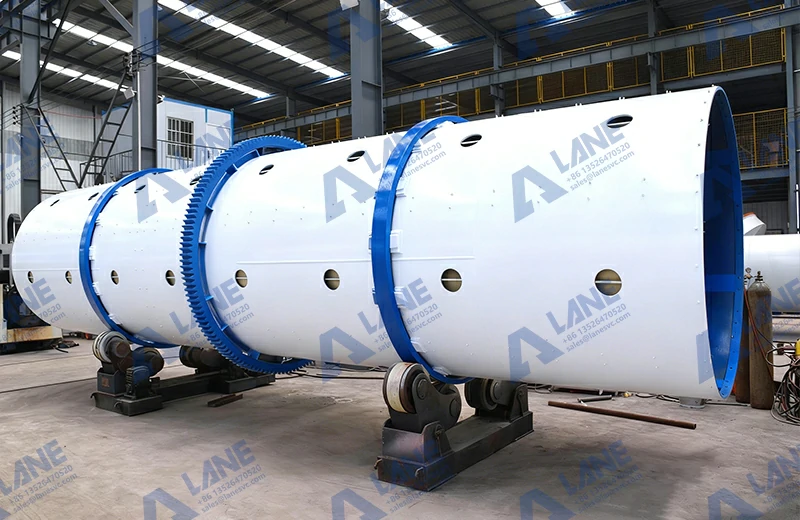
Wet drum granulation uses a rotating drum to agglomerate solids with liquid binders, water, steam, slurry, acid, or reacted material. Material rolls in the drum, building layered granules around seed particles. A dryer, cooler, screens, crushers, recycle system, and coating unit commonly follow.
This approach is often suitable for medium- to large-capacity compound fertilizer and NPK operations where a rounded product and continuous production are important. The key engineering challenge is maintaining the right liquid phase and recycle balance. Too little liquid produces excessive fines; too much can create overgrowth, build-up, and difficult drying.
UNIDO’s Fertilizer Manual documents both wet granulation and compaction routes, illustrating how raw-material properties, liquid-phase control, recycle, screening, drying, and cooling interact in commercial fertilizer plants. UNIDO’s fertilizer process reference remains useful background for early engineering discussions.
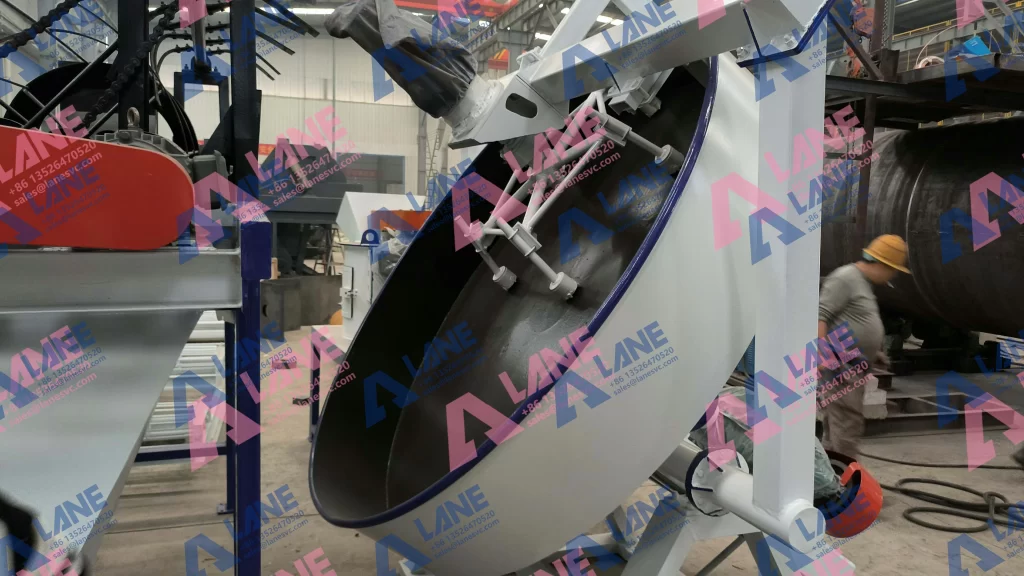
A disc or pan fertilizer granulator machine uses an inclined rotating pan. Fine particles roll across the pan while binder is added, allowing granules to grow by layering. Operators can influence size distribution through pan angle, rotational speed, feed location, binder rate, and recycle quantity.
Pan granulation is valued for its visual process control and can be practical for organic fertilizer, smaller-capacity specialty products, and projects needing relatively simple process access. However, buyers should confirm that the line can manage feed variability and meet the target capacity without excessive manual intervention.
Dry Compaction or Double-Roller Extrusion
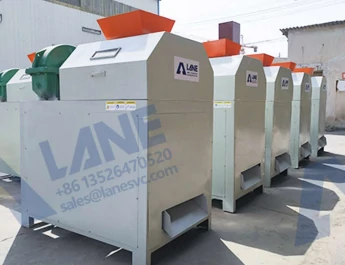
Dry compaction uses opposing rolls to compress a dry, blended formulation into sheets or briquettes. The compacted product is crushed and screened to produce the desired size fraction. Oversize is reduced and undersize is recycled.
This fertilizer granulation process can eliminate the dryer and fuel system, which may reduce thermal energy demand and simplify the line. It is often considered for dry NPK blends, potassium chloride-based products, ammonium sulfate-based products, and projects where water addition is undesirable.
The tradeoff is that compacted granules are usually more irregular than drum-produced granules. Product strength, caking behavior, roll wear, and fines generation must be evaluated against the market’s application and appearance requirements.
Organic Fertilizer Granulation
Organic raw materials introduce different design constraints: variable moisture, fibrous content, biological stability, odor, and the need for composting or fermentation before granulation. A fertilizer granulator machine for compost-based materials may use stirring teeth, drum action, a disc, extrusion, or a combined process depending on feed preparation.
The most common purchasing error is selecting the granulator before confirming feed maturity and moisture-control capability. In organic projects, pre-treatment, crushing, mixing, and moisture conditioning often determine output stability more than the granulator itself.
Build the Plant Around Material Flow
A reliable fertilizer granulation plant design treats the line as one connected system. The core granulator cannot compensate for poor feeding, uneven mixing, insufficient drying, weak screening, or unreliable recycling.
A typical wet-process line may include the following sequence:
- Raw-material receiving and storage
- Crushing or milling of oversize materials
- Metering and batching
- Mixing and conditioning
- Granulation
- Drying
- Cooling
- Screening
- Oversize crushing and fines recycle
- Coating or polishing
- Finished-product storage and bagging
- Dust collection, scrubbing, and centralized controls
In a dry-compaction fertilizer granulation process, drying and cooling may be reduced or omitted, but accurate dosing, compaction, crushing, screening, and recycle control become central to quality.
Raw-Material Storage and Dosing
Storage design should prevent bridging, caking, segregation, and contamination. Fine powders may require different hopper geometry, discharge aids, and feeder types than granular KCl, sticky organic compost, or hygroscopic materials.
Loss-in-weight feeders and calibrated batching systems are particularly valuable when the plant sells multiple nutrient grades. A low-cost feeder can become an expensive bottleneck if it cannot maintain dosing accuracy during material-density changes.
Mixing and Conditioning
Mixing must distribute nutrients and binders evenly before material reaches the granulator. Poor mixing shows up later as inconsistent analysis, weak particles, coating defects, and screen losses.
For reactive or corrosive formulations, specify the material of construction, access doors, seal arrangement, and washdown strategy early. These decisions influence both maintenance cost and worker safety.
Granulation, Drying, Cooling, and Screening
The fertilizer granulator machine forms particles, but final product quality is established by the entire finishing circuit. The dryer removes excess moisture; the cooler stabilizes the product before screening and storage; the screens classify material; and the recycle circuit returns off-size material as seed or feed.
Do not evaluate a granulator only by its nameplate capacity. Request expected capacity at your actual feed properties, target size range, and recycle ratio. These values are more meaningful than a maximum theoretical throughput.
Compare Granulator Technologies Before Buying
| Technology | Best-fit use case | Main advantage | Main tradeoff |
|---|---|---|---|
| Rotary drum | Continuous NPK and compound fertilizers | Rounded granules; scalable output | Dryer, cooler, recycle, and emission controls add complexity |
| Disc | Specialty, organic, and small-to-medium projects | Visible process; adjustable sizing | Can be more sensitive to feed and operator control |
| Double roller | Dry formulations and energy-sensitive projects | No conventional drying stage | Irregular particle shape; roll wear and fines need management |
| Stirring-tooth or wet organic granulator | Prepared compost and organic feeds | Handles certain higher-organic formulations | Feed maturity and moisture consistency are critical |
The best fertilizer granulation plant design may also use hybrid equipment. For example, a primary granulator may be paired with a polishing drum, rounding system, or coating unit to meet a specific market standard.
Design for Utilities, Safety, and Environmental Control
Utilities and environmental systems should be included in the initial scope, not treated as optional additions after the main process equipment is priced.
A wet fertilizer granulation process may require electricity, fuel or steam, process water, compressed air, cooling air, and sometimes scrubber liquid. The engineering package should specify consumption ranges, peak loads, utility quality requirements, and the battery limits between supplier and site.
Dust and vapor control are especially important around crushing, screening, transfer points, bagging, and reactive sections. OSHA notes that fertilizer-industry engineering controls can include closed production systems, ventilation, and protected control rooms, while appropriate dust-control equipment is needed to prevent contamination and dust spread. OSHA’s fertilizer-industry safety reference provides useful context for safety planning.
Ask suppliers to define:
- Dust collection points and air-volume assumptions
- Scrubber duty and recirculation requirements
- Explosion, corrosion, and chemical-exposure considerations
- Access platforms, guarding, lockout points, and maintenance clearances
- Noise-control measures
- Wastewater, spent scrubber liquor, and housekeeping provisions
- Instrumentation required for temperature, moisture, pressure, weight, and motor load

Investment Factors That Determine Project Economics
The capital cost of a fertilizer granulation plant design is influenced by much more than the price of the main equipment. Buyers should use a total-installed-cost model that includes process equipment, steel structure, civil works, utilities, electrical systems, automation, piping, installation, commissioning, freight, duties, training, spare parts, and contingency.
Operating economics should examine:
- Raw-material cost and nutrient availability
- Energy per ton of product
- Labor requirement per shift
- Wear parts and planned maintenance
- Product yield and recycle load
- Off-spec product and rework rate
- Water use and treatment
- Packaging and warehouse handling
- Downtime during grade changeovers
- Local service availability
A lower initial quotation can be misleading if the fertilizer granulator machine has short wear life, limited automation, weak after-sales support, or no documented performance test for the proposed formula.
For investment decisions, develop at least three cases:
- Base case: expected annual volume and normal feedstock quality
- Conservative case: lower sales volume, higher energy cost, and more variable feedstock
- Expansion case: future capacity increase or new product grade
This approach exposes whether a smaller line with modular expansion is financially safer than an oversized installation that will operate far below its efficient range.
How to Evaluate a Fertilizer Equipment Supplier
A supplier should be evaluated as an engineering and lifecycle partner, not only as a machinery vendor. Request clear answers before comparing quotations.
Technical Questions to Ask
- Has the supplier processed feedstocks similar to ours?
- Which fertilizer granulation process do they recommend, and why?
- What product specification is guaranteed?
- What is the expected recycle ratio at normal operation?
- Which parts contact corrosive or abrasive material?
- What tests will be performed before shipment?
- What utility consumption is expected at the guaranteed capacity?
- Which equipment is included and excluded from the scope?
- How will startup, operator training, and remote support be handled?
- What spare parts are recommended for the first 12 to 24 months?
Commercial Questions to Ask
- Is the quotation based on a complete process scope or individual machines?
- Are civil, installation, electrical, and environmental systems included?
- What are the delivery terms, payment milestones, and acceptance criteria?
- Is there a defined performance-guarantee test?
- What documentation will be delivered: PFD, P&ID, GA drawings, motor list, instrument list, manuals, and spare-parts list?
- Can the supplier provide reference projects or credible operating examples?
For a complex installation, use a technical bid-evaluation matrix. Weight process suitability, guarantees, corrosion design, automation, service, delivery, and lifecycle cost more heavily than purchase price alone.
Maintenance Practices That Protect Output
Good maintenance begins in the fertilizer granulation plant design stage. Equipment must be accessible for inspection, cleaning, liner replacement, screen changes, and bearing service.
A practical maintenance program should include:
- Daily checks of feeder accuracy, motor load, vibration, temperature, and leaks
- Routine inspection of granulator liners, drum flights, pan scrapers, and roll surfaces
- Monitoring of screen wear and screen-blinding trends
- Lubrication and alignment checks for drives, chains, bearings, and rollers
- Inspection of ductwork, bags, fans, and scrubber systems
- Planned replacement of wear parts before product quality is affected
- A critical-spares inventory based on actual lead times
The most useful operating indicators are not only tons per hour. Track on-size yield, recycle ratio, moisture after drying, product temperature after cooling, bulk density, fines generation, unplanned downtime, and energy per ton. Together, these measurements reveal whether the fertilizer granulator machine and the line are operating within their intended window.
FAQ: Fertilizer Granulation Plant Design
What is the first step in fertilizer granulation plant design?
Start with a product and feedstock specification: nutrient grades, target granule size, raw-material properties, capacity, operating schedule, and market requirements. Only then should you select the process and equipment.
Which fertilizer granulation process is best for NPK fertilizer?
Wet rotary-drum granulation is often considered for continuous NPK production where rounded granules are required. Dry compaction may suit dry formulations and projects seeking to avoid a conventional drying stage. The right answer depends on formulation, product specification, energy cost, and local market expectations.
How do I choose a fertilizer granulator machine?
Evaluate the machine against your feed moisture, particle size, abrasiveness, required output, desired granule shape, acceptable recycle rate, maintenance capability, and downstream finishing equipment. Ask for testing using representative materials whenever possible.
Does a fertilizer granulation plant need a dryer and cooler?
Many wet granulation lines require both. The dryer reduces product moisture, while the cooler stabilizes granules before screening, coating, storage, and packaging. Dry-compaction lines may have different requirements.
What causes excessive fines in a fertilizer granulation process?
Common causes include poor feed preparation, incorrect moisture or binder rate, unstable recycle, weak granules, worn screens, over-drying, poor cooling, and unsuitable crushing settings. The root cause should be diagnosed across the full line.
What capacity should a new fertilizer plant be designed for?
Design capacity should reflect realistic annual demand, seasonal operating hours, maintenance downtime, product changes, and expansion plans. A capacity model should calculate required average throughput rather than relying on a single peak estimate.
How important is automation in a fertilizer granulation plant?
Automation improves dosing accuracy, repeatability, traceability, and operator response. It is especially valuable for multi-grade NPK plants, but it must be paired with reliable field instruments and clear operating procedures.
What supplier documents should be included in the purchase package?
At minimum, request a process flow diagram, general arrangement drawing, utility list, electrical and instrument lists, equipment specifications, controls narrative, foundation loads, manuals, recommended spares, and acceptance-test criteria.

Send a message to us