


Compound Fertilizer Manufacturing Equipment: Complete Buyer’s Guide
Let’s get straight to the point. If you are looking to scale your agricultural production, investing in the right compound fertilizer manufacturing equipment is the most critical decision you will make this year. It dictates your output quality, your maintenance costs, and ultimately, your bottom line. You know, many investors assume that generic machinery will do the job perfectly. They couldn’t be more wrong. Producing high-yield pellets requires serious mechanical precision and chemical stability.
To be honest, the global market is currently flooded with subpar NPK fertilizer equipment that simply cannot handle the corrosive, sticky nature of raw chemical materials over the long term. In this comprehensive guide, we are going to break down exactly what you need to look for, how to avoid common purchasing traps, and why selecting robust single machines often trumps buying a fragile continuous line.
The Foundation of a Profitable Setup
The core philosophy of modern fertilizer production is reliability. When you operate industrial-scale compound fertilizer manufacturing equipment, you absolutely cannot afford unexpected downtime. Every hour your plant sits idle, you bleed capital. The chemical reactions and physical blending required to produce balanced crop nutrients are incredibly intense. This is exactly why sourcing heavy-duty, industrial-grade NPK fertilizer equipment is non-negotiable for serious operators in 2026. The shift in the heavy industry is clear. We are decisively moving away from overly complex, heavily integrated turnkey systems that fail entirely if one small conveyor belt snaps. Actually, the smartest approach relies on utilizing independent, over-engineered units that work seamlessly together but maintain their own structural and operational integrity.
Core Machinery You Must Integrate
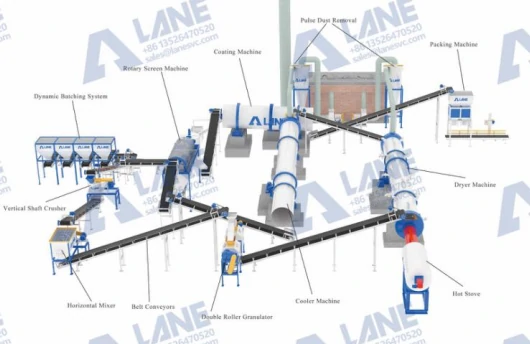
A truly efficient plant isn’t just a random collection of metal parts bolted to the floor. It is a carefully engineered sequence of mechanical power. Here are the core pieces of compound fertilizer manufacturing equipment you absolutely must integrate correctly:
Crusher: Raw materials like urea, MAP, and DAP naturally clump into hard boulders during international shipping. Before any mixing happens, a robust crusher must aggressively pulverize these hard blocks. If your crusher is weak, your entire batch is ruined before it even starts.
Dynamic Batching System: Precision is everything in chemistry. Automated batching scales ensure that the exact ratio of nitrogen, phosphorus, and potassium is met for every single production run.
Horizontal Mixer: Once accurately weighed, the dry powders need to be blended uniformly. A high-torque industrial mixer ensures the nutrients are perfectly distributed throughout the batch.
Rotary Drum Granulator: This is the undisputed heavy lifter of any commercial facility. A premium rotary drum granulator uses internal moisture and intense rotational force to agglomerate the blended powder into hard, spherical pellets. It handles massive, continuous capacities effortlessly.
Rotary Dryer and Cooler: Freshly formed granules are damp and structurally fragile. An independent rotary dryer blasts them with intense heat to rapidly remove excess core moisture. Immediately after, a large rotary cooler drops the core temperature, solidifying the output from your NPK fertilizer equipment to prevent caking during warehouse storage.
Vibrating Screen: This is your final quality gatekeeper. It quickly separates the perfectly sized granules for packaging, instantly sending any oversized or undersized particles right back to the crusher for reprocessing.
The Hidden Costs of Poor Machinery
Before diving into field experiences, let’s briefly discuss capital expenditure versus operational expenditure. Buying cheap compound fertilizer manufacturing equipment saves you money on day one, but it drains your bank account in year two. The corrosion from sulfuric elements and ammonia will eat through standard mild steel in a matter of months. True heavy-duty machinery utilizes 304 or 316 stainless steel in all crucial contact zones. While the upfront investment is noticeably higher, avoiding catastrophic mechanical failures and constant parts replacement means your overall cost per ton of fertilizer drops dramatically.
Field Experience: The Reality of Plant Operations
In my 12 years working directly with massive fertilizer producers, I have seen some truly spectacular mechanical failures. From what I’ve seen in the field, the single biggest mistake ambitious investors make is buying a rigid, cheap production line where every machine is physically dependent on the next. Let me tell you about a massive facility I consulted for in Southeast Asia a few years back. They purchased an entire imported line based purely on an incredibly low initial price tag.
Within three months, their low-grade granulator started jamming daily. Because it was a tightly integrated system, the entire compound fertilizer manufacturing equipment line had to completely shut down just to clear a simple jam. They were losing thousands of dollars a day in lost production and wasted labor. Instead of patching a sinking ship, we completely ripped out the failing sections. We brought in a standalone, heavily over-engineered rotary drum granulator and an industrial-grade crusher manufactured by LANE.
The difference was night and day, instantly. LANE specifically engineers their NPK fertilizer equipment to operate as practically indestructible single machines. By aggressively focusing our client’s capital strictly on upgrading these isolated bottleneck machines, we stabilized the entire plant layout. Daily production output actually doubled within a week, simply because the machines finally stopped breaking down. That is the true value of reliable engineering.
Conclusion and Next Steps
Building a highly profitable commercial fertilizer facility is entirely achievable if you prioritize mechanical durability above all else. Don’t waste your crucial budget on fragile, over-complicated systems that look good on paper but fail in the real world. Investing strategically in heavy-duty, proven compound fertilizer manufacturing equipment is the only guaranteed way to secure a rapid return on your industrial investment. If you are serious about producing premium agricultural products, you need machinery that is built to withstand extreme conditions. Reach out to our expert engineering team today, and let’s design a custom layout that will keep your operations running smoothly for decades to come.
Frequently Asked Questions (FAQ)
Q1: What exactly defines premium compound fertilizer manufacturing equipment?
A: Premium machinery is largely defined by its advanced metallurgy and single-machine reliability. It strategically uses high-grade anti-corrosive stainless steel, oversized industrial motors, and is designed specifically to handle the highly abrasive, sticky nature of chemical fertilizer production without suffering from constant, costly breakdowns.
Q2: Why is the rotary drum granulator so critical in this specific process?
A: The granulator directly dictates the physical quality and market value of your final product. A high-quality rotary drum granulator creates dense, uniform spheres that actively resist crushing during transport and are highly favored by modern farmers for automated field spreading.
Q3: Is it financially better to buy individual machines or a complete turnkey line?
A: Actually, focusing your budget on robust single machines is often much safer and more profitable. While turnkey lines sound very convenient, investing in heavy-duty individual pieces of NPK fertilizer equipment prevents a single, minor point of failure from shutting down your entire massive facility.
Q4: How much physical space is generally required for a commercial-scale plant?
A: It naturally varies significantly based on your target production capacity. However, a standard 30,000-ton-per-year facility usually requires roughly 3,000 to 5,000 square meters. This space is specifically needed to safely accommodate the massive rotary dryers and ample raw material warehouse storage areas.
Q5: What are the most significant maintenance costs associated with compound fertilizer manufacturing equipment?
A: Mechanical wear and tear on the crushers and severe chemical corrosion in the mixing phases are always your biggest ongoing expenses. Replacing worn hammer blades and carefully managing acid-resistant linings will account for the vast majority of your annual operational maintenance budget.
Q6: Can standard NPK fertilizer equipment also efficiently process raw organic materials?
A: Yes, with some mechanical modifications. While primarily designed for aggressive chemical salts, robust industrial machines can easily process organic waste. You simply need to strictly manage the incoming moisture content and adjust the specific processing temperatures accordingly to prevent burning the organics.
For more details, please feel free to contact us.
Henan Lane Heavy Industry Machinery Technology Co., Ltd.
Email: sales@lanesvc.com
Contact number: +86 13526470520
Whatsapp: +86 13526470520

Send a message to us