


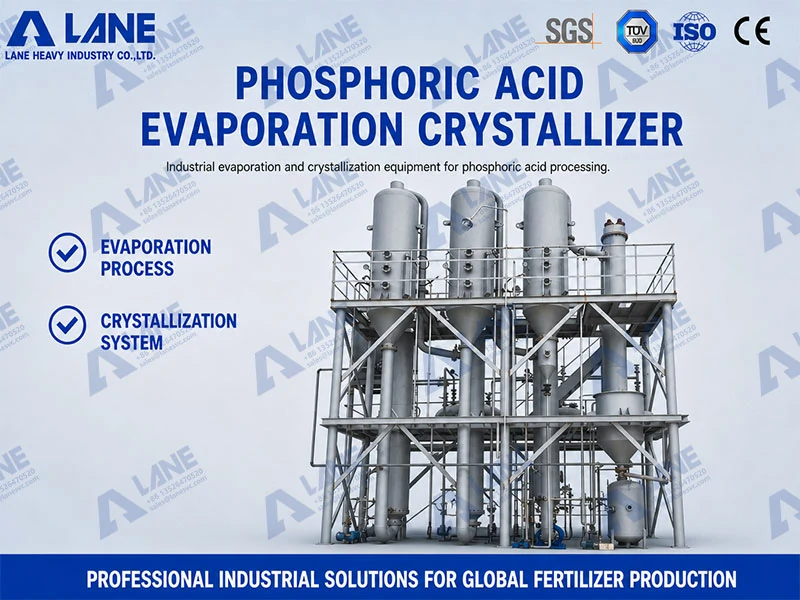
Phosphoric Acid Evaporation Crystallizer
The Phosphoric Acid Evaporation & Crystallization System is designed to concentrate phosphoric acid and provide controlled crystallization when required. It is widely used in phosphate fertilizer and phosphorus chemical production.
In wet-process phosphoric acid production, the system removes excess water through controlled heating and evaporation, increasing acid concentration for downstream production of MAP, DAP, TSP, SSP and other phosphate fertilizers.
The system can be customized according to acid concentration, processing capacity, final concentration, heating medium and downstream process requirements.
1. Working Principle and Process Flow
The basic process consists of feed preparation, preheating, evaporation, vapor separation, concentration and, when required, crystallization and solid-liquid separation.
Step 1: Phosphoric Acid Feed
Dilute or intermediate-concentration phosphoric acid is transferred from the upstream phosphoric acid production section to the evaporation system.
Before entering the evaporator, the feed can be filtered or pretreated to remove suspended solids and reduce the risk of scaling or fouling.
Step 2: Preheating
The phosphoric acid is preheated using steam, hot water, thermal oil or another suitable heat source.
Preheating improves thermal efficiency and helps maintain stable evaporation conditions.
Step 3: Evaporation and Concentration
The preheated phosphoric acid enters the evaporation chamber or evaporator.
Under controlled heating and pressure conditions, water is evaporated from the phosphoric acid solution. The generated vapor is separated from the concentrated acid and can be further treated or reused depending on the process design.
For heat-sensitive or highly corrosive phosphoric acid systems, suitable vacuum evaporation technology can be adopted to reduce the boiling temperature and improve equipment operating conditions.
Step 4: Vapor-Liquid Separation
The vapor and concentrated phosphoric acid are separated through a vapor-liquid separator or evaporation chamber.
The separated vapor can be condensed, discharged through the appropriate treatment system, or reused as a heat source where the process permits.
Step 5: Further Concentration
If a higher acid concentration is required, the phosphoric acid can pass through additional evaporation stages.
Multi-effect evaporation can be considered for projects requiring improved energy efficiency and reduced steam consumption.
Step 6: Crystallization
When the production process requires crystallization, the concentrated solution is transferred to a crystallizer.
By controlling temperature, supersaturation, residence time and cooling conditions, the dissolved components can form crystals with the desired characteristics.
Step 7: Solid-Liquid Separation
The resulting crystal slurry can be transferred to a centrifuge, vacuum filter or other solid-liquid separation equipment.
The recovered crystals can then be washed, dried or sent directly to the next production stage according to the final product requirements.
Typical Process Flow
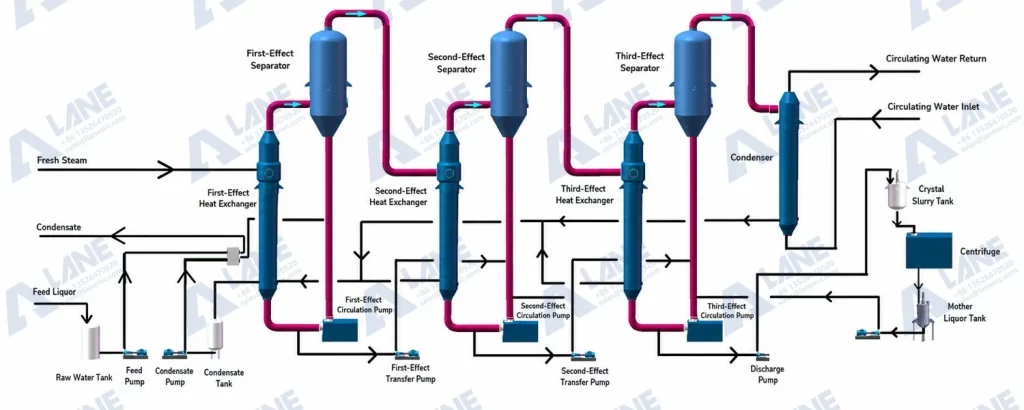
Phosphoric Acid Feed → Preheating → Evaporation → Vapor-Liquid Separation → Acid Concentration → Crystallization → Solid-Liquid Separation → Product / Downstream Process
The actual process flow can be modified according to the raw material composition and final fertilizer production requirements.
2. Main Equipment Components
A complete phosphoric acid evaporation and crystallization system may include the following equipment:
2.1 Feed Tank
The feed tank provides temporary storage and stable feeding of phosphoric acid to the evaporation system.
It can be equipped with level measurement, temperature monitoring and agitation when necessary.
2.2 Preheater
The preheater increases the temperature of the incoming phosphoric acid before evaporation.
Heat recovery can be incorporated into the design to reduce overall energy consumption.
2.3 Evaporator
The evaporator is the core equipment for removing water from phosphoric acid.
Depending on the process conditions, different evaporator configurations can be selected, including forced-circulation, falling-film or other customized designs.
2.4 Vapor-Liquid Separator
The separator removes entrained liquid droplets from the generated vapor and separates vapor from concentrated phosphoric acid.
Efficient separation helps reduce acid carryover and protects downstream equipment.
2.5 Crystallizer
The crystallizer provides controlled supersaturation and crystal growth conditions when crystallization is required.
Different crystallization configurations can be selected according to the type of crystal, production capacity and required particle characteristics.
2.6 Circulation Pump
Circulation pumps maintain stable material flow between the evaporator, heater and crystallizer.
Corrosion-resistant materials and suitable pump configurations can be selected according to the phosphoric acid concentration and operating conditions.
2.7 Condenser
The condenser cools and condenses the generated vapor.
The recovered condensate may be reused within the plant when its quality is suitable.
2.8 Vacuum System
A vacuum system can be installed when vacuum evaporation or low-temperature operation is required.
It helps reduce the boiling point and can improve evaporation efficiency under suitable process conditions.
2.9 Crystal Separation Equipment
Depending on the process, centrifuges, vacuum filters or other separation equipment can be used to separate crystals from the mother liquor.
2.10 Piping, Instrumentation and Control System
The complete system can be integrated with:
- Temperature and pressure sensors
- Flow meters
- Level control
- Automatic valves
- PLC control system
- Vacuum control
- Steam and condensate control
- Safety and interlock systems
This enables stable and automated operation of the evaporation and crystallization process.
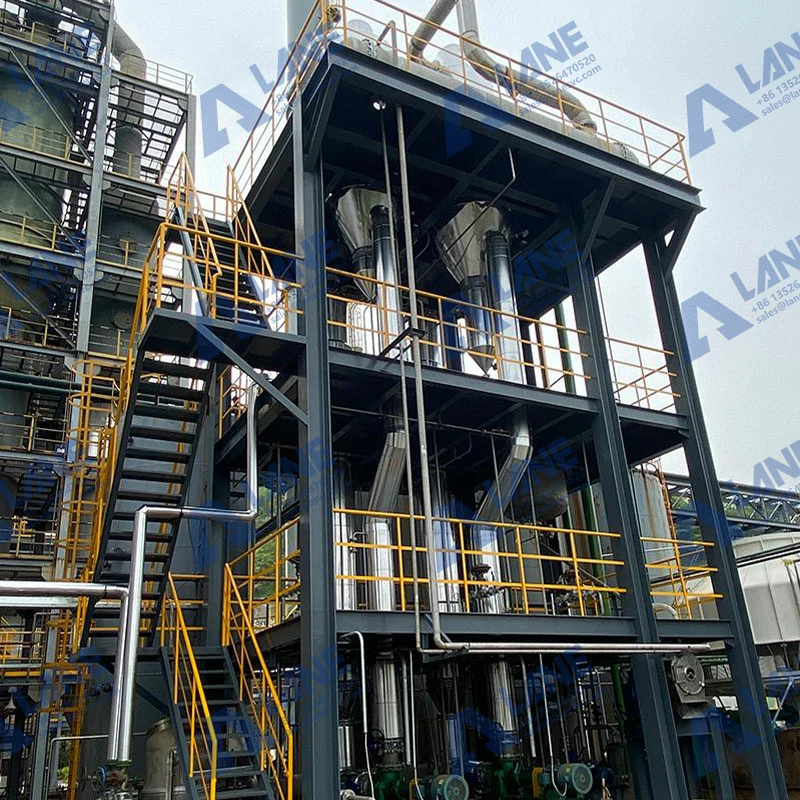
3. Applications in Phosphate Fertilizer Production
The phosphoric acid evaporation and crystallization system can be integrated into various phosphate fertilizer and phosphorus chemical projects.
Wet-Process Phosphoric Acid Concentration
One of the main applications is the concentration of wet-process phosphoric acid before it enters downstream fertilizer production.
The concentrated acid can be used as a feedstock for different phosphate fertilizer processes.
DAP and MAP Production
Concentrated phosphoric acid is an important feedstock for Diammonium Phosphate (DAP) and Monoammonium Phosphate (MAP) production line.
The evaporation system helps provide phosphoric acid at the concentration required by the downstream ammoniation and granulation process.
TSP Production
For Triple Superphosphate (TSP) production line, phosphoric acid reacts with phosphate rock to produce a high-phosphate fertilizer.
Stable acid concentration is important for maintaining consistent reaction and product quality.
SSP and Other Phosphate Fertilizers
Phosphoric acid concentration and related thermal processes can also be incorporated into integrated phosphate fertilizer projects, depending on the selected production technology.
Phosphoric Acid and Phosphate Chemical Processing
Beyond fertilizer manufacturing, the system can also be used in selected phosphorus chemical processes where concentration, evaporation, crystallization or recovery of dissolved components is required.
4. Key Advantages
Efficient Concentration
The system is designed to efficiently remove water and increase phosphoric acid concentration for downstream processing.
Flexible Process Configuration
Single-effect or multi-effect evaporation, atmospheric or vacuum operation, and different crystallization configurations can be selected according to project requirements.
Corrosion-Resistant Construction
Phosphoric acid is corrosive, particularly under certain concentration and temperature conditions. Equipment materials and internal components can therefore be selected according to the actual process medium and operating conditions.
Energy-Saving Options
Heat recovery, multi-effect evaporation and optimized vapor utilization can be incorporated to reduce steam consumption and improve overall thermal efficiency.
Automated Operation
PLC-based control and online monitoring can be used to control temperature, pressure, flow rate, liquid level and other key parameters.
Customized for Fertilizer Projects
The system can be engineered according to the customer’s phosphoric acid concentration, production capacity, raw material characteristics and downstream fertilizer process rather than relying on a one-size-fits-all configuration.
5. Why Choose a Customized Evaporation & Crystallization System?
Phosphoric acid evaporation is not simply a water-removal process. The characteristics of the acid, impurities, solids content, concentration, temperature and scaling tendency can significantly affect equipment selection and operating performance.
For this reason, a properly designed system should consider:
- Phosphoric acid concentration
- Feed temperature
- Required final concentration
- Evaporation capacity
- Phosphate rock characteristics
- Impurity and suspended-solid content
- Scaling and corrosion conditions
- Heating medium
- Vacuum requirements
- Energy consumption
- Downstream fertilizer process
- Required automation level
Based on these parameters, the evaporation, separation and crystallization sections can be configured as an integrated system.
6. Suitable for Integrated Phosphate Fertilizer Projects
For fertilizer manufacturers and investors planning a new phosphate fertilizer plant, the Phosphoric Acid Evaporation & Crystallization System can serve as an important process section between phosphoric acid production and downstream fertilizer manufacturing.
It can be integrated with phosphate rock processing, phosphoric acid production, acid concentration, DAP/MAP/TSP production, crystallization, drying, cooling, screening and fertilizer packaging systems to create a complete production solution.
If you are planning a new phosphate fertilizer project, provide us with your phosphoric acid concentration, required capacity, raw material composition and target fertilizer product. Our engineers can recommend a suitable evaporation and crystallization configuration based on your process requirements.
Latest Articles & Tips
More-
01/19
SOP Fertilizer Caking Prevention TechnologySOP Fertilizer Caking Prevention Technology: Solutions for High-Quality Potash Production: Solutions for High-Quality Potash Production
read more -
09/09
read moreGlobal Potassium Sulfate Demand Growth: The Importance of Sulphate of Potash Production Line Equipment Selection
-
09/16
read more -
01/21
read more