


Poultry Manure Organic Fertilizer Production Process Explained: From Raw Material to Finished Product
The demand for organic poultry manure fertilizer has grown steadily across global agricultural markets — and the reasons aren’t hard to understand. Poultry manure is one of the most nutrient-dense natural inputs available, rich in nitrogen, phosphorus, and potassium. But raw manure pulled straight from a poultry house is a different story entirely. Left unprocessed, it carries pathogens, releases ammonia, and can damage crops rather than feed them. The poultry manure organic fertilizer production process exists to solve that problem — converting a farm waste stream into a stable, safe, and commercially competitive soil amendment.
What follows is a stage-by-stage breakdown of how that transformation happens, covering both the process logic and the key equipment at every step.
Why Processing Matters More Than Most People Realize
A lot of producers underestimate this part — and it tends to be what catches them off guard later. Raw poultry manure typically carries moisture levels between 65% and 80%, depending on flock type and housing conditions. At those levels, it can’t be bagged, can’t be efficiently transported, and can’t be applied with any useful consistency. The biological load — E. coli, Salmonella, weed seeds — makes direct field application genuinely risky, especially near food crops.
Proper processing changes all of that. Moisture is reduced. Pathogens are destroyed through sustained heat. Nutrients stabilize into plant-available forms. The finished organic poultry manure fertilizer bears almost no resemblance to the raw material that entered the system. That gap — in safety, consistency, and commercial value — is larger than most people expect until they’ve seen both ends of the process firsthand.
Stage 1: Raw Material Collection and Pre-Treatment
Everything starts at the source. Poultry manure is collected from broiler houses, laying hen operations, or duck farms, often combined with litter materials like rice husks, sawdust, or wood shavings. That mixture directly influences moisture content and carbon-to-nitrogen ratio — both of which affect how well fermentation performs downstream.
Before composting begins, oversized debris must be removed: feathers, stones, clumped litter. A solid-liquid separator handles initial moisture reduction, which is especially critical when processing fresh slurry. Getting moisture below 60% before fermentation isn’t optional. It’s the baseline that makes the next stage work.
Stage 2: Fermentation and Composting
If one stage defines the quality of the finished organic poultry manure fertilizer, it’s this one. Aerobic fermentation, when managed correctly, raises internal pile temperatures to 55°C–70°C — hot enough to destroy pathogens and sterilize weed seeds, while initiating the humification of organic compounds.
The primary equipment here is the crawler-type compost turner — also called a tracked compost turner. It straddles windrow rows of stacked manure and mechanically turns the material at regular intervals, maintaining oxygen flow throughout the pile. Without consistent turning, anaerobic zones develop, fermentation stalls, and odor problems follow quickly.
Fermentation cycles typically run 15 to 25 days. Ambient temperature, feedstock composition, and inoculant use all play a role. In my experience working alongside facilities that have genuinely optimized this stage — tighter aeration schedules, targeted microbial programs — the quality improvement in finished compost is immediately recognizable. Darker color, that earthy smell, a crumbly texture that holds together without clumping. You learn to read it.
Stage 3: Crushing and Screening
Fully fermented compost comes out uneven — clumped, compressed, inconsistent in particle size. It can’t go straight to a granulator. It needs to be broken down first.
A chain plate crusher or semi-wet material crusher handles this task. These machines are designed for post-fermentation moisture levels of 30% to 40%, processing material thoroughly without clogging. A rotary drum screening machine then separates oversized particles and foreign material from the usable fraction. Consistent particle size going into granulation is essential — variability at this stage compounds downstream.
Stage 4: Granulation
This is where the poultry manure organic fertilizer production process shifts from agricultural handling into something closer to precision manufacturing. Processed powder is converted into uniform, stable granules — easier to store, transport, and apply with field equipment.
Common granulator options include:
- Disc granulator : Suited for smaller-scale output; produces round, uniform granules through rolling agglomeration.
- New type organic fertilizer granulator: A horizontal stirring design built for organic feedstocks, handling higher fiber content without caking.
- Rotary drum granulator: The standard choice for large-scale continuous lines — efficient, reliable, and easily automated.
Equipment selection depends on output targets, feedstock type, and budget. Manufacturers like LANE, which specializes in large-scale fertilizer production machinery, typically recommend the rotary drum granulator for annual production targets above 10,000 tons.
Stage 5: Drying, Cooling, and Coating
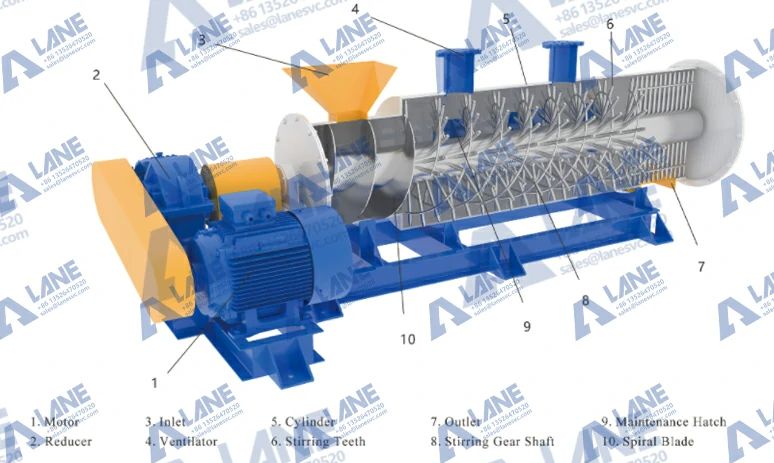
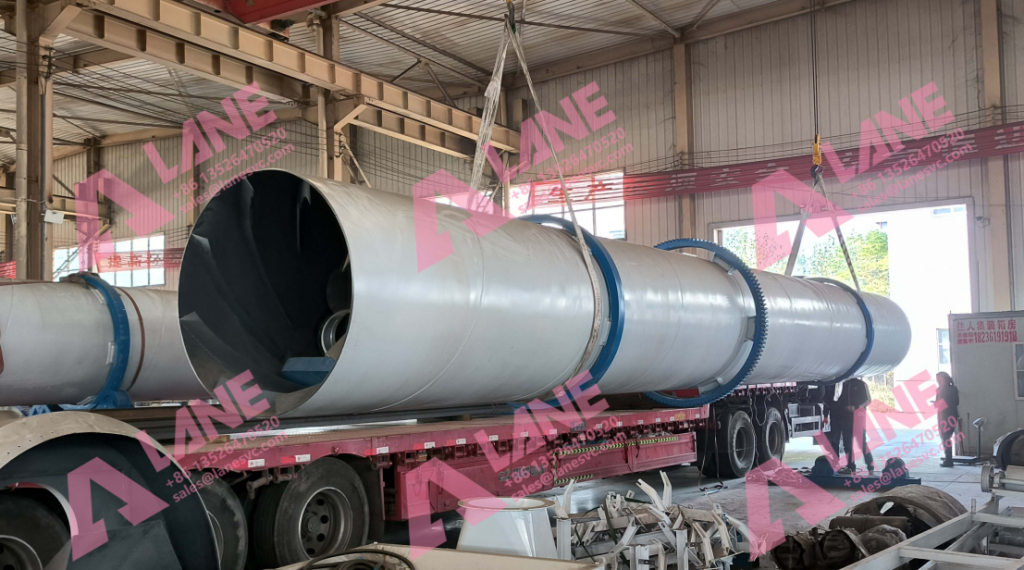
Fresh granules carry 20% to 30% moisture coming off the granulator. A rotary drum dryer brings that below 10% — the threshold for safe long-term storage. Immediately after, a rotary drum cooler drops granule temperature back toward ambient. This step gets overlooked more than it should; hot granules going into bags will cake and degrade quickly.
Coating, applied via a rotary coating machine, is optional but increasingly common in commercial organic poultry manure fertilizer lines. It improves granule appearance, reduces handling dust, and can modify nutrient release rates depending on the coating material selected.
Stage 6: Screening, Packaging, and Storage
A final pass through a vibrating screening machine removes off-spec granules, which return to the crusher for reprocessing. Nothing is wasted — the loop closes cleanly, and product consistency is maintained throughout.
Packaged organic poultry manure fertilizer moves through either a ton bag packaging machine for bulk 500kg–1,000kg formats, or an automatic bagging machine for retail-sized bags with integrated weight control and labeling.
FAQ
Q: How long does the full poultry manure organic fertilizer production process take?
The complete cycle from raw manure to finished packaged product typically runs 25 to 40 days, with fermentation accounting for the majority of that time.
Q: What is the NPK content of finished organic poultry manure fertilizer?
Typical figures are N: 2–4%, P₂O₅: 2–5%, K₂O: 1–2%, plus trace micronutrients. Exact values vary with feedstock and process conditions.
Q: Can the production line be scaled?
Yes. Modular equipment configurations support capacity from 1 ton per hour up to 20+ tons per hour without changing the fundamental process structure.
Q: Is organic poultry manure fertilizer suitable for all crop types?
Broadly yes — it performs particularly well with vegetable crops, fruit trees, and cash crops that respond to slow-release organic nutrition. Local soil conditions and nutrient baselines should always be evaluated first.
Final Thoughts
The poultry manure organic fertilizer production process is, at its core, a value conversion system. It takes something most farms classify as a liability and turns it into a product with genuine market demand and proven agronomic benefit. Every stage builds on the one before it — skip a step or underinvest in equipment, and inconsistency becomes a persistent problem.
For producers or investors considering this space, the starting point is straightforward: understand the process, know the equipment, and recognize where quality is built or lost. The technology is mature. The market for certified organic poultry manure fertilizer continues to expand. Execution is what separates the operations that thrive from the ones that struggle.
For more details, please feel free to contact us.
Henan Lane Heavy Industry Machinery Technology Co., Ltd.
Email: sales@lanesvc.com
Contact number: +86 13526470520
Whatsapp: +86 13526470520
Send a message to us